TL;DR: A reliable vehicle wrap printing machine must deliver consistent graphics on compatible printable films while supporting proper drying, lamination, and installation. A 1.6–1.85m eco-solvent printer can be practical for smaller vehicle wrap shops, while 2.5–3.2m equipment may provide additional width for large-scale graphics production. However, printable film compatibility, accepted output, finishing capacity, and operating costs matter more than headline printing speed.
Vehicle wrapping businesses face a common equipment investment challenge: choosing a printing system that balances image quality, production efficiency, material compatibility, and long-term profitability.
A machine may produce attractive graphics during a demonstration yet fail to meet commercial requirements if the film cannot conform to the vehicle, the ink has not dried adequately, or the production workflow creates excessive waste.
This engineering-oriented buying guide compares equipment configurations across four purchasing criteria, examines critical vehicle graphics production requirements, and provides a practical three-step selection method for wrap shops, fleet branding companies, and international printing equipment buyers.
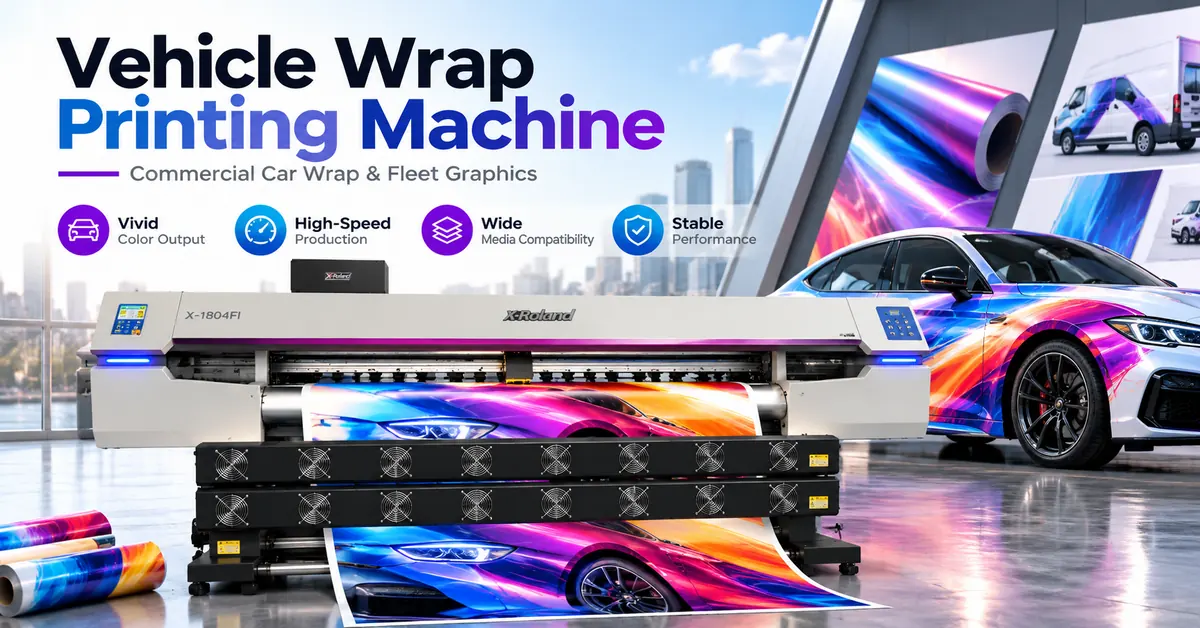
How Do Vehicle Wrap Printing Machine Configurations Compare Side by Side?
Table 1 compares two common equipment categories for commercial vehicle graphics production: 1.6–1.85m printers and 2.5–3.2m printers.
| Comparison Dimension | Option A: 1.6–1.85m Printer | Option B: 2.5–3.2m Printer | Best Fit / Decision Rule |
|---|---|---|---|
| Printing Width | Suitable for many decals, partial wraps, and panelized graphics | Accommodates wider media and larger artwork layouts | Match usable width to actual film rolls and panel designs |
| Production Capacity | Available in single-head and multi-head configurations | Available with multiple printhead and media-handling configurations | Compare accepted output, not width alone |
| Material Handling | Generally suited to narrower production workflows | Requires sufficient space and handling for wider rolls | Check film dimensions, tension, take-up, and workshop layout |
| Investment Economics | Worth evaluating for smaller or developing wrap businesses | Worth evaluating for wider jobs and established production demand | Compare total equipment investment against job volume and contribution margin |
Comparison conclusion: Smaller-format configurations may be a more practical starting point for companies producing decals and partial wraps, while wider equipment offers additional production flexibility when sufficient demand exists.
However, printing width alone does not determine output quality. A properly configured narrower printer may produce better finished wraps than a wider machine operating with unsuitable media or incorrect RIP settings.
For available configurations, explore the X-Roland eco-solvent printer range.
Key Takeaways
-
Choose the printing width according to actual vehicle graphics orders. A 1.6–1.85m machine may be sufficient for many wrap businesses, while wider configurations are worth considering for larger layouts and diversified commercial signage production.
-
Prioritize the complete printing system. Printable cast film, compatible ink, color profiles, proper drying, qualified overlaminate, and professional installation collectively influence wrap quality.
-
Evaluate cost per accepted job. Printing speed alone does not account for material waste, drying, lamination, trimming, installation, or reprints.
-
Verify machine performance before purchasing. Request demonstrations using the exact printable film and representative vehicle graphics artwork.
-
Check technical support and production documentation. The supplier should clarify equipment configuration, maintenance, spare parts, and available training before an order is placed.
The Process Behind the Numbers: X-Roland Vehicle Graphics Equipment Evaluation
Vehicle wrap equipment selection should combine manufacturer specifications with application-specific material and production testing.
X-Roland, associated with Guangzhou Jihui Electronic Equipment Co., Ltd., provides roll-fed printing equipment with different widths, printhead quantities, ink configurations, and media-handling systems.
Its published equipment service process emphasizes understanding customer materials, artwork, production requirements, and desired output before recommending a solution.
For this comparison, equipment parameters are based on X-Roland product specifications, while film processing considerations are informed by published technical guidance from Avery Dennison and 3M.
Technical evaluation basis: Manufacturer-listed printing widths, printhead quantities, and reference speeds are used for initial equipment comparison. Film conformability, drying, lamination, and installation requirements must be verified against the selected material manufacturer's instructions.
This article does not represent an independently conducted X-Roland performance test or an unpublished customer production study.
Which Printing System Provides Better Vehicle Wrap Quality?
Vehicle graphics quality depends on the interaction between printing technology, ink, printable film, and finishing operations.
Eco-solvent printing can be suitable for commercial vehicle graphics when the ink and film are compatible.
Latex printing is another option for qualified vehicle graphics systems, while some flexible UV-curable technologies may be suitable for specific conformable materials.
The critical distinction is not which technology has the most impressive marketing description, but which complete system meets the intended film and installation requirements.
Printable Film Compatibility Across Applications
| Vehicle Graphics Application | Preferred Material Consideration | Production Requirement |
|---|---|---|
| Full vehicle wrap | Qualified conformable printable cast film | Curves, recesses, film stability, approved laminate |
| Partial wrap | Appropriate cast or approved alternative film | Panel alignment and application geometry |
| Flat vehicle decals | Qualified printable adhesive film | Adhesion, durability, and removal requirements |
| Fleet branding | Consistent and qualified film system | Repeatable color and documented installation |
| Vehicle window graphics | Approved perforated or specialty film | Visibility and applicable vehicle-use restrictions |
For full vehicle wraps, qualified cast films are commonly used because of their conformability and dimensional stability.
Some calendered materials may be suitable for simpler applications, but they should not automatically be used on compound curves or deep recesses.
Avery Dennison's Instructional Bulletin 1.17 discusses vehicle wrapping and conforming applications, including film selection, ink compatibility, and processing requirements.
3M also publishes product-specific technical guidance for its vehicle graphics films.
Technical recommendation: Select the intended film and overlaminate first, then confirm that the proposed printing system can process that material according to its published requirements.
How Does Printing Speed Affect Vehicle Wrap Production?
Printing speed is an important purchasing factor, but the actual commercial objective is to produce acceptable finished graphics within the required deadline.
X-Roland publishes reference output figures for several relevant equipment models.
| X-Roland Model | Printhead Configuration | Listed Width | Published 4-Pass Speed |
|---|---|---|---|
| XL-1601H | 1 × Epson I3200 | 1600 mm media | 23 m²/h |
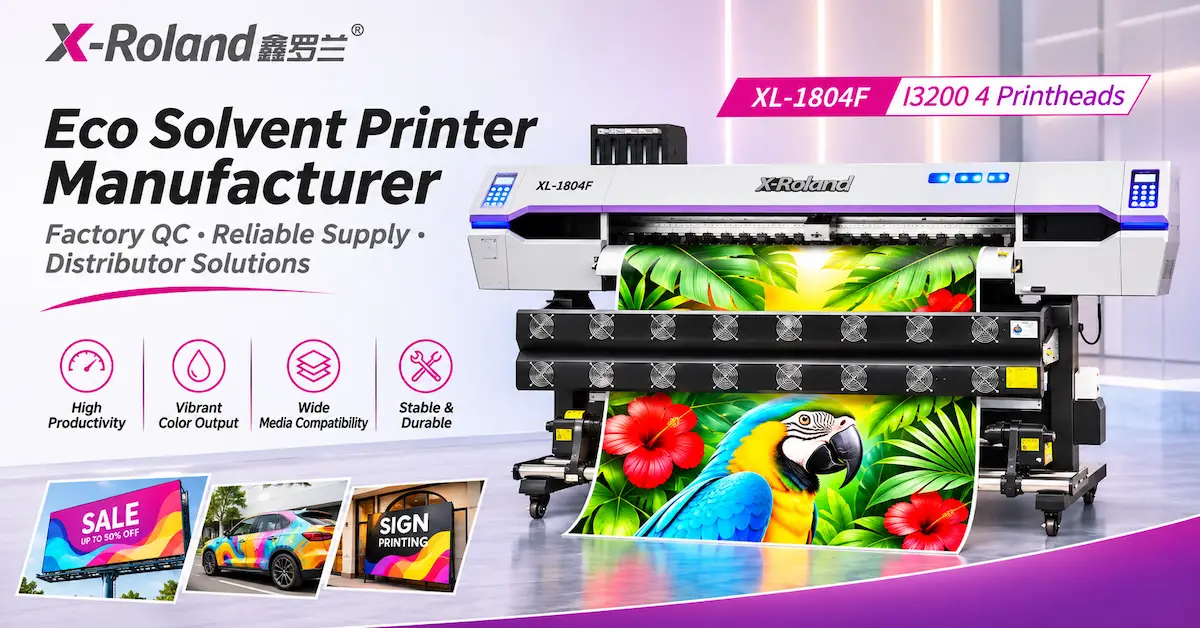
| XL-1804F | 4 × Epson I3200 | 1850 mm media | 76 m²/h |
| XL-2500Y | 2 × I3200 option | 2500 mm print width | 38 m²/h |
| XL-3202Q | 2 × I3200 option | 3200 mm | 30 m²/h |
| XL-3202FA | 2 × Epson I3200 | 3200 mm media | 53 m²/h |
These are published machine reference specifications. They are not measured using identical vehicle wrap films, printing profiles, or artwork. The XL-1804F also has separate UV-related configurations; buyers must confirm the eco-solvent version.
Practical Production Speed Test Method
Step 1: Use the actual vehicle wrap film. Ask the supplier to print on a qualified film intended for your normal customer orders, using the appropriate color profile.
Step 2: Measure accepted printed output. Record printing time, usable graphic area, banding, registration, and rejected sections.
Step 3: Include the finishing workflow. Account for drying, lamination, cutting, panel preparation, and quality inspection before calculating real throughput.
A machine advertised at 76 m²/h cannot automatically be assumed to deliver 76 m² of finished, installation-ready vehicle graphics every hour.
The distinction becomes increasingly important when fleet projects require identical graphics across multiple vehicles.
When Does In-House Vehicle Wrap Printing Become More Economical Than Outsourcing?
Equipment investment becomes more attractive when the additional contribution generated by in-house production justifies the printer, software, maintenance, consumables, and finishing resources.
However, there is no universal number of vehicles at which purchasing a printer becomes profitable.
The break-even point depends on the company's actual order volume, outsourced production prices, material costs, available labor, and equipment utilization.
In-House Printing vs Outsourced Production
| Cost Factor | In-House Printing | Outsourced Graphics Production |
|---|---|---|
| Initial equipment investment | Printer and supporting equipment required | No printing equipment investment |
| Consumable purchasing | Film, ink, laminate, and maintenance supplies | Usually incorporated into supplier charges |
| Production control | Managed internally | Depends on external supplier capacity |
| Quality responsibility | Internal printing and inspection | Shared according to supplier arrangements |
| Production flexibility | Depends on available machine time | Depends on external turnaround |
| Long-term economics | Can improve with sufficient profitable utilization | May suit irregular or low-volume demand |
Calculating the Financial Break-Even Point
A practical calculation is:
Break-even job volume = Monthly additional fixed costs ÷ Contribution advantage per accepted job
For example, assume a hypothetical print shop has:
-
Additional monthly fixed costs of $900 for in-house production.
-
A $45 contribution advantage per completed wrap job compared with outsourcing.
The illustrative break-even volume would be:
$900 ÷ $45 = 20 accepted jobs per month
This example is a calculation method, not a verified market price, current equipment quotation, or X-Roland customer result.
Actual calculations should include financing, depreciation policy, maintenance, material waste, downtime, and the cost of finishing equipment.
Procurement insight: A printer can offer good technical performance but still be a poor investment if the business cannot maintain sufficient profitable production volume.
What Are the Main Film Drying and Lamination Constraints?
One of the most common causes of vehicle wrap production problems is treating printing, drying, and lamination as completely independent operations.
For eco-solvent printing, sufficient drying and solvent release before lamination are essential.
Avery Dennison's Instructional Bulletin 1.17 describes a minimum 72-hour drying requirement for certain solvent and eco-solvent printed conforming and fleet graphics before overlamination.
Other products may have different instructions. Drying time must therefore follow the exact selected film and ink system, environmental conditions, and ink coverage.
Key Processing Constraints
Ink deposition: Excessive ink can increase retained solvent and affect film processing.
Drying environment: Temperature, humidity, ventilation, and storage arrangement influence drying.
Lamination compatibility: The selected protective laminate must be qualified for the printed film and intended application.
Film deformation: Incorrect laminate tension or temperature can stretch materials and affect dimensions.
Installation geometry: The film must be suitable for the vehicle's curves, recesses, edges, and surface coating.
Application conditions: Surface preparation and installation temperature must follow the film manufacturer's instructions.
A professional vehicle wrap printing machine evaluation should include all these factors before equipment approval.
How Does Vehicle Wrap Order Volume Influence Printer Selection?
Different production volumes create different requirements for machine capacity, media width, and finishing workflow.
Production Volume and Equipment Trade-Offs
| Business Stage | Potential Equipment Direction | Main Decision Factor |
|---|---|---|
| New or low-volume wrap studio | Outsourcing or evaluating a compact roll-fed printer | Avoiding underutilized equipment |
| Growing vehicle graphics business | 1.6–1.85m printer with adequate finishing capability | Repeatability, cost, and manageable throughput |
| Established fleet branding operation | Higher-output printing configuration | Production scheduling and color consistency |
| Large commercial graphics producer | Evaluate 2.5–3.2m configurations where useful | Wider media, diversified work, and available capacity |
These are qualitative decision categories rather than fixed production-volume thresholds.
X-Roland Models for Different Requirements
The XL-1601H provides a single-I3200-head roll-fed platform with 1600mm listed media width.
The XL-1804F offers a four-I3200-head configuration and a listed 1850mm media width.
The XL-2500Y provides 2500mm maximum print width with dual-head configuration options.
For wider operations, the XL-3202Q lists a 3200mm width, while the XL-3202FA provides a 3200mm media-width configuration with a published maximum media load of 150kg.
The best selection depends on order structure, suitable wrap-film dimensions, tested production quality, and available finishing capacity.
How Can Buyers Select a Vehicle Wrap Printing Machine in Three Steps?
A simple selection process can help purchasing managers avoid comparing specifications without considering the actual production application.
Step 1: Define the Vehicle Graphics and Film Requirements
Action: Identify the vehicles, intended wrap coverage, printable film products, graphics dimensions, and installation conditions.
Decision rule: If the project requires deep curves or conforming panels, prioritize qualified wrap films and compatible printing technology. Reject any proposed combination that cannot meet the film manufacturer's application requirements.
Step 2: Verify the Printing and Finishing Process
Action: Request printed samples using your artwork, target film, appropriate RIP profile, drying procedure, and qualified overlaminate.
Decision rule: Select only a configuration that produces acceptable graphic quality and remains suitable after the required processing and installation checks.
Step 3: Compare Production Volume and Total Costs
Action: Calculate monthly accepted output, material waste, operating expenses, finishing costs, and the potential contribution from bringing printing in-house.
Decision rule: Choose the equipment configuration that meets production requirements at a sustainable cost, rather than simply selecting the highest advertised printing speed.
Recommended Combined Production Workflow
-
Vehicle and graphic requirements assessment
-
Film and ink system confirmation
-
Printing and color verification
-
Required drying and lamination
-
Cutting and panel preparation
-
Application testing and final inspection
This sequence can be used as a practical supplier evaluation checklist.
Application Scenario: Planning Production for a Commercial Fleet Wrap Project
Consider a hypothetical fleet branding business preparing graphics for 12 delivery vans.
The company wants to produce consistent printed graphics while reducing dependence on outsourced printing.
This is an illustrative planning scenario, not a documented X-Roland customer project.
Initial Production Requirements
Assume each vehicle requires approximately 16m² of finished graphic coverage.
The total finished area would be:
12 vehicles × 16m² = 192m²
If the production plan assumes an additional 15% of material for overlaps, trimming, layout losses, and contingency, estimated material use would be:
192m² × 1.15 = 220.8m²
The actual allowance must be calculated from panel drawings and real job requirements.
Step 1: Identify the Main Production Risks
The company should evaluate three potential issues:
-
Variation in brand colors between vehicles.
-
Insufficient drying before overlamination.
-
Waste caused by layout errors, unsuitable film, or reprints.
A high printing speed does not remove these risks.
Step 2: Establish a Controlled Production Process
The company should first approve a complete sample using the intended film, printer, ink, and laminate.
Then it should save the approved artwork, RIP settings, and print profile.
Before full fleet production, the operator should confirm drying requirements and inspect an installed sample on representative vehicle surfaces.
Step 3: Compare Equipment Capacity
A smaller printer might process the project successfully if panel layout, scheduling, and available production time are sufficient.
A wider configuration may be worth considering if the company also produces large commercial signage or requires additional media-width flexibility.
The decision should be based on tested capacity and total investment rather than a presumed performance advantage.
Expected Evaluation Benefits
This structured process enables the buyer to:
-
Define measurable print and finishing acceptance criteria.
-
Estimate material purchasing requirements.
-
Identify whether printer throughput is genuinely the main bottleneck.
-
Compare equipment quotations on consistent terms.
-
Reduce uncertainty before investing in production equipment.
No cost reduction or productivity improvement is claimed without actual project results.
FAQs
Q1: What is the best printing technology for commercial vehicle wraps?
Eco-solvent and latex printing are both established options for compatible vehicle wrap films. Certain flexible UV-curable systems may also be suitable for approved applications. The best option depends on the exact film, ink, curing or drying requirements, and installation conditions.
Q2: Is a 1.6m eco-solvent printer sufficient for vehicle wrapping?
A 1.6m printer can produce many vehicle graphics, including decals, partial wraps, and panelized full-wrap designs. The required width should be determined from actual film rolls, artwork layouts, and finishing allowances.
Q3: How long should eco-solvent prints dry before lamination?
Drying depends on the selected film, ink, environmental conditions, and ink coverage. Some Avery Dennison technical instructions require at least 72 hours for conforming and fleet graphics. Always use the latest instructions for the exact media system rather than assuming a universal drying time.
Q4: Which is better for a wrap business: a single-head or four-head printer?
A four-head system may offer higher potential printing throughput, but the better choice depends on commercial workload, printing quality, operating costs, and maintenance requirements. Buyers should compare accepted output with the same film and representative artwork.
Q5: What causes vehicle wrap graphics to lift or fail after installation?
Possible causes include unsuitable film, inadequate surface preparation, retained solvent, incorrect stretching, incompatible laminate, or installation errors. Examine the complete material and installation process before attributing a failure to the printer.
Q6: How can I determine whether buying a vehicle wrap printer is profitable?
Compare the total monthly costs of in-house production with current outsourcing expenses and expected completed jobs. Include consumables, printing and finishing labor, maintenance, rejected output, depreciation, and financing where applicable. Use actual business data to calculate break-even volume.
Conclusion & Technical Guidance
Selecting a vehicle wrap printing machine requires an application-based assessment of printing quality, material compatibility, production requirements, and total operating costs.
For smaller studios producing partial wraps and customized decals, a 1.6–1.85m printer may offer suitable production capabilities. Larger graphics businesses may benefit from the additional width available in 2.5–3.2m configurations, provided the wider equipment matches their actual workload.
However, printer dimensions and advertised speed cannot substitute for qualified film selection, controlled drying, compatible overlamination, and professional installation.
The most reliable purchasing strategy is to verify the complete printing workflow before investing.
By reviewing representative production samples, measuring accepted output, and calculating costs per completed job, vehicle graphics businesses can make more informed equipment decisions and reduce preventable production risks.
X-Roland Vehicle Graphics Equipment & Technical Support
Looking for a vehicle wrap printing solution for a new print shop, an expanding graphics business, or a commercial fleet branding operation?
X-Roland provides roll-fed printing equipment configurations for different commercial graphics requirements. Its published service process includes application review, equipment recommendations, sample evaluation, and support discussions.
For a more relevant technical recommendation, prepare:
-
Your target vehicle types and graphics applications.
-
Preferred printable film and laminate specifications.
-
Printing width and expected monthly production volume.
-
Representative artwork and required print quality.
-
Workshop space, electrical requirements, and delivery destination.
Contact X-Roland for Vehicle Graphics Printer Recommendations
You can also explore the X-Roland product range and printing equipment services to review the available configurations and support approach before requesting a quotation.