TL;DR: Before requesting a quotation from an eco solvent printer manufacturer, buyers should confirm six essentials: the supplier's manufacturing role, application compatibility, exact machine configuration, sample-print evidence, installation requirements, and post-purchase support. A low quoted price is not useful if the printhead variant, software package, media handling, or service responsibilities remain unclear. A structured pre-quote evaluation helps buyers eliminate unsuitable options and receive more accurate, comparable proposals.
For sign shops, advertising businesses, equipment distributors, and international importers, requesting machinery prices is often the easiest part of sourcing.
The harder task is determining whether a manufacturer understands the work the equipment must perform.
Two suppliers may quote printers with similar widths and printhead quantities while offering different ink configurations, RIP software packages, media-handling capabilities, and technical support.
An eco solvent printer manufacturer should therefore be evaluated against the buyer's intended production requirements before a formal request for quotation (RFQ) is issued.
This guide introduces a pre-RFQ qualification process that helps buyers shortlist suitable manufacturers, identify essential supporting evidence, and prepare clearer commercial inquiries.
What Should Buyers Verify Before Requesting a Printer Quote?
The following six-part evaluation separates product suitability from supplier claims.
| Evaluation Area | Evidence to Request | Decision Question |
|---|---|---|
| Manufacturer identity | Company details and production responsibilities | Who controls equipment manufacturing and configuration? |
| Application fit | Media compatibility and representative use cases | Can the proposed system produce the required graphics? |
| Technical configuration | Exact model, printheads, ink system and software | Is the equipment specification sufficiently clear? |
| Sample capability | Printing samples with recorded conditions | Can the supplier demonstrate the required output? |
| Installation readiness | Electrical, space, ventilation and operating requirements | Can the equipment be installed appropriately? |
| Support arrangements | Training, warranty and service information | Who helps the buyer after delivery? |
Pre-quote decision rule: If the supplier cannot identify a suitable machine configuration or explain how its output can be verified, requesting a detailed price may be premature.
Key Takeaways
-
Evaluate the finished application first. Printer width and speed matter only when the system supports the intended media and production requirements.
-
Verify exact configurations. A printhead family name does not establish the correct ink chemistry or complete printing setup.
-
Use sample evidence, not marketing images alone. Request printing results using relevant artwork and qualified materials.
-
Clarify installation requirements early. Electrical supply, ventilation, floor space and consumables affect the feasibility of purchasing.
-
Compare quotation scope consistently. Software, accessories, training, shipping and support can change the real acquisition cost.
-
Separate pre-RFQ screening from factory acceptance testing. Supplier qualification identifies promising options; later testing verifies the ordered machine.
What Should an Eco Solvent Printer Manufacturer Prove Before an RFQ?
The first objective is confirming that the supplier can explain its role in producing and supporting the equipment.
A company may manufacture complete printers, assemble machinery from purchased components, distribute equipment manufactured elsewhere, or perform several of these activities.
These distinctions matter because they affect configuration control and technical accountability.
1. Company Identity and Manufacturing Role
A buyer should be able to identify the legal business, operating location, equipment portfolio and production responsibilities.
Useful evidence includes current company information, production-area images, descriptions of assembly activities and access to technical personnel.
Factory ownership alone does not establish superior quality. The important issue is whether responsibilities are transparent and verifiable.
2. Relevant Product Experience
A supplier familiar with textile printers is not automatically the best choice for a business producing solvent-printed outdoor signs.
Ask which product models are intended for adhesive vinyl, banners, backlit films and other qualified media.
The supplier should explain the relevant printing and finishing requirements instead of claiming universal material compatibility.
3. Technical Communication
A professional manufacturer should be able to answer configuration questions consistently.
For example, buyers should ask how printing width is defined, which ink system is installed, which RIP software is included, and how the selected print mode affects output.
Qualification principle: Favor specific, traceable answers over unsupported claims such as “fastest,” “maintenance-free,” or “compatible with all materials.”
Why Should Application Compatibility Be Checked Before Price?
Printer quotations become more useful when they reflect real production tasks.
An equipment distributor may need to support several customer segments. A sign shop may produce everything from small decals to large outdoor banners.
These businesses should not automatically receive the same equipment recommendation.
Application-to-Equipment Screening Matrix
| Application | Typical Material | Main Technical Question |
|---|---|---|
| Commercial stickers | Qualified printable adhesive vinyl | Can the system provide required detail and finishing compatibility? |
| Outdoor banners | Compatible flexible banner media | Can the machine feed and dry the selected material consistently? |
| Backlit displays | Qualified translucent printing film | Does the image meet requirements under illumination? |
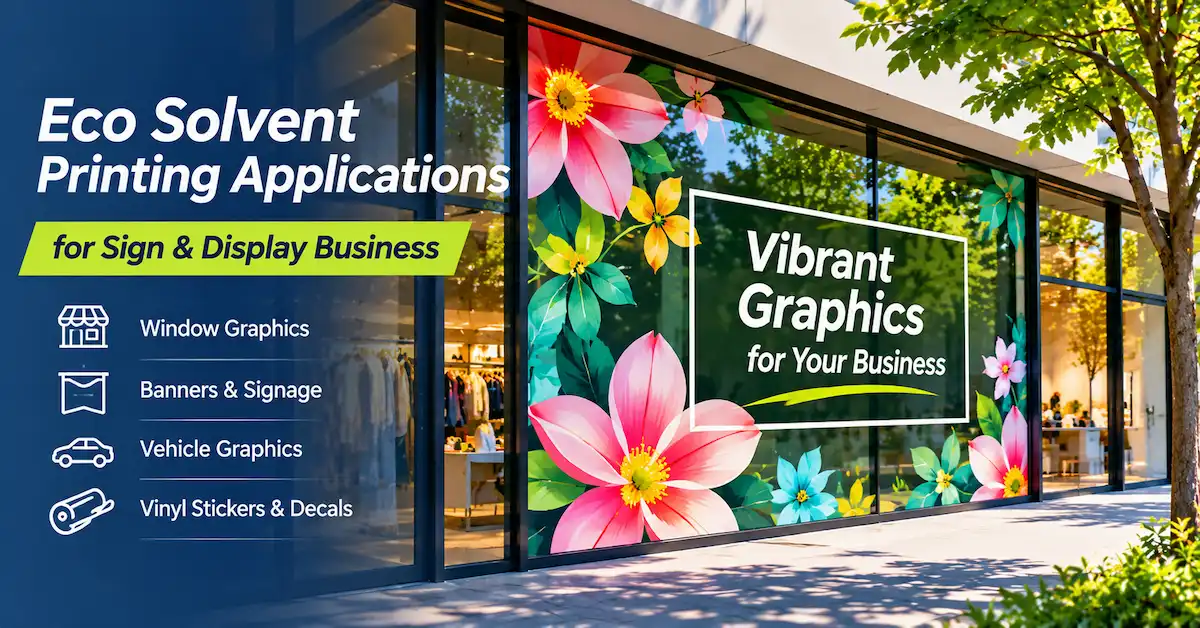
| Window advertising | Suitable films and graphic media | Are color, opacity and dimensional requirements supported? |
| Vehicle graphics | Qualified vehicle-wrap vinyl | Can the printed graphic meet the required lamination and application process? |
An eco solvent printer manufacturer should help buyers narrow the equipment configuration according to these requirements.
When Should a Buyer Consider Another Printing Technology?
If the project mainly involves direct printing onto rigid materials, a UV flatbed solution may be more appropriate.
If the application is polyester textile sublimation, a compatible sublimation workflow may be necessary.
Selecting the right technology before requesting prices prevents the buyer from comparing machines that cannot perform the same work.
How Should Buyers Verify Printheads and Ink Systems?
One of the most important pre-quote checks is identifying the complete printing configuration.
A printer specification may state that it uses an Epson I3200 printhead, but that description does not by itself identify the ink chemistry or all operating requirements.
Epson's official I Series printhead specifications distinguish variants intended for different ink systems, including aqueous, UV and eco-solvent applications.
This technical distinction is important when reviewing a commercial printer quotation.
Configuration Evidence Checklist
| Component | Information Required Before RFQ |
|---|---|
| Printhead | Exact variant and quantity |
| Ink system | Approved eco-solvent formulation |
| Printing width | Media width and usable image width |
| Controller | Installed controller and supported functions |
| RIP software | Name, version and licensing terms |
| Media handling | Roll dimensions, loading and take-up arrangements |
| Drying system | Included equipment and applicable settings |
| Maintenance | Approved cleaning materials and operating procedures |
Different ink configurations should not be treated as interchangeable unless the manufacturer explicitly supports the required arrangement.
Technical recommendation: Ask for a model-specific specification sheet before comparing suppliers' quotations.
Which X-Roland Eco Solvent Printer Models Are Worth Comparing?
X-Roland, associated with Guangzhou Jihui Electronic Equipment Co., Ltd., offers several eco-solvent printer configurations for commercial signage applications.
Its portfolio includes narrower single-head equipment and wider multi-head systems.
X-Roland Model Comparison
| Model | Listed Width | Printhead Configuration | Published 4-Pass Speed | Potential Application |
|---|---|---|---|---|
| XL-1601H | 1600mm media | 1 × Epson I3200 | 23m²/h | Small and medium commercial signage |
| XL-1804F | 1850mm media | 4 × Epson I3200 | 76m²/h | Higher-output commercial graphics |
| XL-3202Q | 3200mm width | 2 × I3200 or F1080 option | 30m²/h with I3200 | Wide-format advertising |
| XL-3204Q | 3200mm width | 4 × Epson I3200 | 60m²/h | Higher-volume wide-format production |
These values are taken from the manufacturer's published model information. Printing speeds are reference figures under specific modes, not standardized comparative test results. Buyers must verify the selected configuration and actual production requirements.
XL-1601H: Single-Head Commercial Printing
The X-Roland XL-1601H lists a 1600mm media width, one I3200 printhead, three-stage drying and a continuous ink supply system.
It may be relevant to buyers serving commercial sign shops that require a practical roll-fed printing configuration.
XL-1804F: Multi-Head Graphics Production
The XL-1804F lists four Epson I3200 printheads and an 1850mm media width.
Its published equipment features include temperature control, adjustable pressure rollers and drying equipment.
Confirm the exact eco-solvent version before purchase.
XL-3202Q and XL-3204Q: Wide-Format Equipment
The XL-3202Q offers a 3200mm dual-head platform.
The XL-3204Q lists four I3200 printheads on a 3200mm platform.
These models may suit buyers serving larger advertising and wide-format production markets.
Important: The comparison identifies possible equipment options. It does not establish which configuration is best without knowing the buyer's materials, quality requirements and expected production workload.
What Printing Evidence Should Buyers Request?
Before requesting a detailed quotation, buyers should determine whether the manufacturer can demonstrate relevant print quality.
A promotional machine photo does not establish color accuracy, media compatibility or repeatable output.
Four Types of Useful Evidence
Representative artwork: Provide designs containing gradients, fine text, solid colors and customer-specific imagery.
Relevant substrates: Use qualified media similar to the materials intended for commercial production.
Recorded printing conditions: Request the print mode, ink configuration, media specification and RIP information.
Finished-graphic assessment: Evaluate the print after required drying, lamination or other finishing steps.
How Should Sample Quality Be Judged?
| Criterion | What to Inspect |
|---|---|
| Color | Appearance against the approved reference |
| Fine detail | Text and line reproduction |
| Registration | Alignment of printed image elements |
| Banding | Uniformity in solid colors and gradients |
| Drying | Appropriate condition for subsequent handling |
| Material suitability | Performance on the intended qualified substrate |
At the pre-RFQ stage, the buyer may initially review existing representative samples or agree on a proposed testing method.
Detailed factory acceptance testing can be arranged later, once the equipment specification and commercial terms are defined.
What Installation and Operating Information Must Be Confirmed?
An eco solvent printer manufacturer should be able to describe the basic installation requirements of the proposed machine.
These include equipment dimensions, electrical specifications, loading access, ventilation, maintenance space and approved consumables.
A machine may fit within the stated floor area while still requiring additional clearance for loading rolls or servicing components.
Why Should Buyers Check Ventilation?
Eco-solvent inks still contain solvent-related substances that require appropriate handling.
The UK Health and Safety Executive's COSHH guidance for digital inkjet printing includes guidance for wide-format printing with solvent-based inks.
This official reference supports the recommendation to assess workplace ventilation, chemical exposure, operating procedures and applicable safety requirements.
The precise controls depend on the ink, equipment, tasks and local regulations.
Procurement rule: Request installation information and applicable Safety Data Sheets rather than assuming that the term “eco-solvent” means no workplace precautions are necessary.
How Should After-Sales Support Be Screened Before an RFQ?
Technical support should be reviewed during the initial manufacturer evaluation, not only after the printer has been purchased.
At this stage, buyers do not need to negotiate every repair procedure. They should establish whether a credible support arrangement is available.
Ask who handles initial troubleshooting, what training can be provided, how spare parts are identified, and which warranty terms apply.
X-Roland's equipment support information describes application review, equipment recommendations, sample evaluation, operator setup support and after-sales response.
However, available support hours, warranty coverage, replacement-parts availability and commercial commitments should be confirmed for the specific order.
What Information Should Buyers Prepare Before Requesting a Quote?
A well-prepared RFQ helps an eco solvent printer manufacturer propose a suitable configuration without making assumptions about the customer's operation.
Pre-RFQ Information Sheet
| Field | Information to Provide |
|---|---|
| Business type | Sign shop, printing factory, distributor or reseller |
| Main applications | Stickers, banners, backlit graphics, vehicle graphics |
| Target substrates | Actual materials or approved media categories |
| Required width | Typical and maximum finished graphic dimensions |
| Output requirement | Expected daily or monthly accepted production |
| Print quality | Representative artwork and required result |
| Preferred equipment | Model or configuration under consideration |
| Installation location | Country, electrical requirements and available space |
| Service requirements | Training, spare parts and technical support expectations |
| Commercial requirements | Quantity, shipping destination and preferred delivery terms |
What Should a Complete Quotation Specify?
A useful proposal should identify the machine model, printhead and ink configuration, included accessories, RIP software, initial consumables, warranty, packaging and delivery terms.
If the buyer requires OEM/ODM customization, the available branding or configuration scope should be stated separately.
Production lead time, MOQ and pricing should be requested rather than assumed.
Why Is Quote Normalization Important?
Two equipment prices are not directly comparable when they include different items.
Use the same acquisition-cost framework:
Comparable acquisition cost = Machine price + Required software and accessories + Freight and import-related costs + Installation preparation + Initial consumables
For example, a hypothetical $5,800 printer requiring $900 of additional equipment may have a higher relevant acquisition cost than a $6,400 package that includes the necessary components.
The appropriate comparison depends on the actual scope of each quotation, not the headline price.
How Can Buyers Score a Manufacturer Before Requesting Prices?
A simple internal evaluation scorecard can help purchasing teams compare evidence consistently.
Suggested Pre-RFQ Qualification Scorecard
| Qualification Area | Suggested Weight |
|---|---|
| Application and substrate fit | 25 |
| Configuration documentation | 20 |
| Sample evidence and testing capability | 20 |
| Installation readiness | 10 |
| Service and technical communication | 15 |
| Commercial scope transparency | 10 |
| Total | 100 |
This is a proposed buyer evaluation tool, not a third-party certification or a verified score assigned to any manufacturer.
A supplier with incomplete technical information may require additional clarification before a detailed quotation is worthwhile.
Critical incompatibilities, serious safety concerns or misleading documentation should be resolved regardless of the numerical score.
What Is the Best Three-Step Manufacturer Evaluation Process?
Step 1: Confirm Technical and Application Fit
Action: Provide the intended materials, finished-product sizes and production requirements.
Decision rule: Shortlist only manufacturers offering a potentially suitable printing configuration.
Step 2: Verify Evidence and Communication
Action: Review model specifications, printhead information, sample capability, installation requirements and support arrangements.
Decision rule: Move forward when essential technical questions have credible, traceable answers.
Step 3: Issue a Complete RFQ
Action: Send a consistent project brief to shortlisted suppliers and request comparable equipment packages.
Decision rule: Evaluate detailed quotations only after confirming that the proposed machines can support the intended work.
This approach avoids comparing prices for technically different or unsuitable equipment.
Application Scenario: An Overseas Distributor Preparing Its First RFQ
Consider a hypothetical equipment distributor seeking commercial printers for regional sign shops.
The distributor expects customers to produce adhesive vinyl graphics, banners and retail advertising materials.
Instead of immediately requesting prices from several manufacturers, it first identifies the common customer applications and required widths.
It then reviews model specifications, checks the availability of compatible eco-solvent configurations, and asks suppliers whether they can demonstrate relevant print samples.
After clarifying installation and service expectations, the distributor sends the same requirements to the shortlisted companies.
What Does This Approach Improve?
The purchasing team can compare proposals against a consistent project definition.
It is less likely to confuse different printhead configurations, exclude necessary software from cost comparisons, or select machinery unsuitable for the intended application.
This scenario is illustrative and does not represent a documented customer project or guaranteed cost saving.
Why Evaluate X-Roland Before Requesting an Eco Solvent Printer Quote?
X-Roland is associated with Guangzhou Jihui Electronic Equipment Co., Ltd., a Chinese printing equipment company established in 2013.
Its official website describes activities involving printing equipment research, manufacturing and sales.
The company's About page outlines a workflow connecting customer requirements, material review, printing calibration, production monitoring and final inspection.
Its Eco Solvent Printer product category includes several models with different media widths and printhead configurations.
For commercial buyers, these published resources provide a starting point for evaluating suitable equipment.
Specific manufacturing arrangements, customization capabilities, certifications, factory testing, order quantities and after-sales commitments should still be verified for the actual purchase.
Ready to discuss a suitable configuration? Contact X-Roland with your substrates, required print width, expected output and destination market to begin the equipment selection process.
Frequently Asked Questions
1. How do I evaluate an eco solvent printer manufacturer?
Start with business identity, intended applications, model specifications, printhead and ink compatibility, sample-print evidence, installation requirements and technical support. Request a detailed quotation only after clarifying the essential requirements.
2. Is a manufacturer always better than a trading company?
No. The important issues are product suitability, transparent responsibilities, reliable documentation and support arrangements. A factory-based manufacturer may provide more direct technical coordination, but this must be assessed rather than assumed.
3. What information should I request before asking for a printer price?
Request the exact model, usable printing width, printhead variant, ink system, software information, media compatibility, installation specifications and available sample-testing options.
4. Why does the Epson I3200 variant matter?
The I3200 family includes different ink-compatible variants. Buyers must confirm the actual installed printhead and qualified ink system rather than assuming every I3200 configuration is interchangeable.
5. Can I compare printers using published printing speeds?
Published speeds provide an initial reference, but they may represent different quality modes and conditions. Ask for output evidence using representative artwork and the required media.
6. Should I request printed samples before an RFQ?
Representative sample evidence is useful during initial qualification. More detailed buyer-specific testing can be negotiated once a suitable equipment configuration has been identified.
7. What after-sales service questions should I ask?
Clarify training, troubleshooting channels, warranty scope, spare-parts sourcing and available service arrangements. Obtain written terms before purchasing.
8. Should a manufacturer provide compliance certificates?
Buyers should request documentation relevant to the exact machine and destination market. A generic certificate should not be assumed to cover every model, electrical configuration or regulatory requirement.
9. Can I request OEM/ODM customization?
Potential customization depends on the manufacturer's actual capabilities and the selected equipment. Confirm branding options, technical changes, order quantities and commercial terms before making commitments.
10. How can I request an accurate X-Roland quotation?
Provide your applications, materials, printing widths, production targets, destination country, purchasing quantity and support requirements. Request an itemized proposal specifying the selected equipment configuration.
Conclusion
Evaluating an eco solvent printer manufacturer before requesting a quote can help international buyers avoid unsuitable equipment choices and incomplete commercial comparisons.
The most useful initial checks are application suitability, exact technical configuration, credible sample evidence, installation readiness and post-purchase support.
Price comparisons become more meaningful only when manufacturers are quoting equipment against the same requirements.
For businesses sourcing commercial printing machinery, a structured pre-RFQ process creates a clearer path from initial supplier screening to technical evaluation and eventual purchasing.
X-Roland provides eco-solvent printing equipment options and publishes information about model configurations, manufacturing processes and customer support.
Looking for an eco solvent printer manufacturer for your printing business or distribution network? Contact X-Roland to discuss your applications, obtain technical specifications and request a tailored equipment quotation.