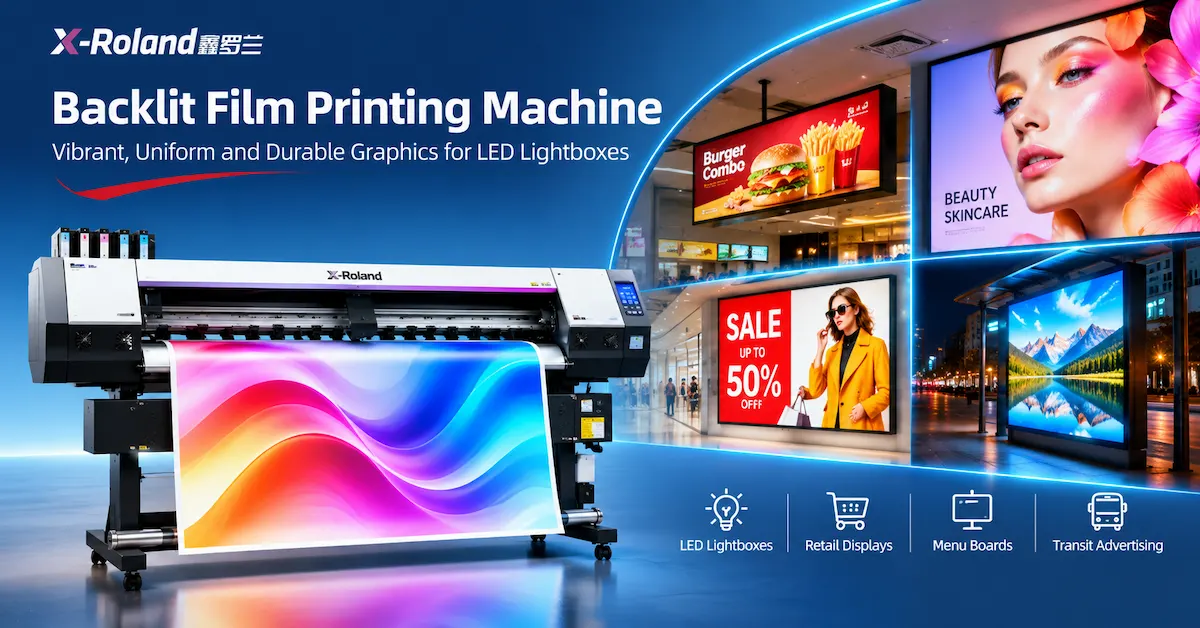
TL;DR: Choosing a large format printer manufacturer in China begins with the finished product, not the machine catalog. Buyers should identify their substrates, required image dimensions, ink technology, expected production volume, finishing process, and operating budget before comparing printers. Eco-solvent systems are suitable for many flexible signage applications, UV systems serve qualified flexible or rigid materials, and sublimation systems address compatible textiles. The right equipment delivers acceptable finished output at a sustainable cost—not simply the highest advertised printing speed.
Buyers searching for large format printer manufacturer China should compare printing technologies, substrate compatibility, usable width, and production capacity before requesting equipment quotations.
For international printing equipment distributors, sign manufacturers, advertising companies, and commercial print shops, purchasing a wide-format printer is a production-planning decision.
A machine that performs well on adhesive vinyl may not be the correct solution for rigid acrylic panels, polyester fabrics, or stretch-ceiling films.
Similarly, a wider or faster printer may provide little commercial advantage when most customer orders are narrow, low-volume, or require extensive finishing.
This guide explains how to compare printing technologies, assess equipment capacity, evaluate verified X-Roland models, and prepare a purchasing request that reflects actual production requirements.
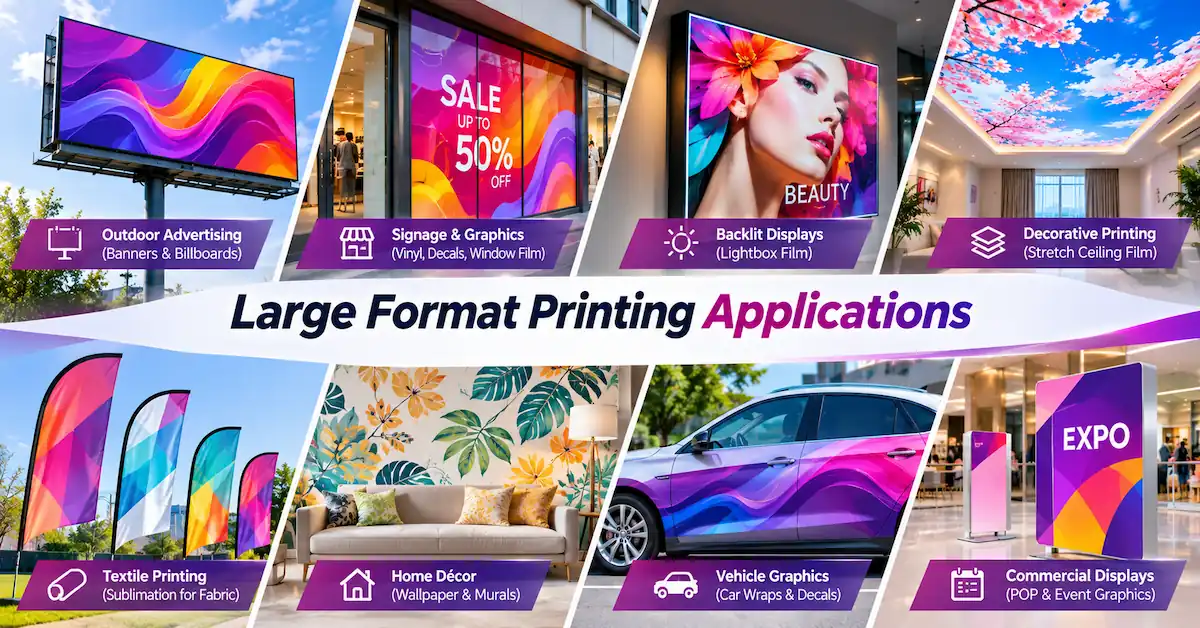
Which Large Format Printing Technology Fits Your Application?
The first step is choosing the correct printing process.
Different technologies use different ink systems, substrates, drying or curing methods, and downstream equipment.
| Printing Technology | Typical Applications | Main Advantages | Key Buying Considerations |
|---|---|---|---|
| Eco-solvent roll-to-roll | Vinyl graphics, banners, decals, posters, suitable backlit media | Flexible commercial signage production | Ink/media compatibility, drying, lamination, ventilation |
| UV roll-to-roll | Qualified films, banners, wallpapers and flexible display media | UV curing on compatible materials | Ink flexibility, adhesion, curing, media handling |
| UV flatbed | Suitable rigid boards, acrylic, wood, metal and display panels | Direct printing onto qualified rigid substrates | Bed size, substrate thickness, adhesion, curing |
| Sublimation printing | Compatible polyester textiles, sportswear, flags and soft signage | Suitable for selected textile applications | Fabric composition, transfer/direct process, heat fixation |
| Specialty decorative-film printing | Stretch-ceiling films and selected architectural decoration | Application-specific production workflows | Film flexibility, stretch resistance, lighting and finishing |
Technical conclusion: The correct printing technology depends primarily on the substrate and finished-product requirements.
A general-purpose roll-fed eco-solvent printer cannot automatically replace a UV flatbed printer for rigid panels or a sublimation printer for polyester textile production.
Buyers can explore the X-Roland printing equipment portfolio to identify relevant equipment categories before requesting model-specific specifications.
Key Takeaways
-
Select the printing process first. Substrate compatibility matters more than advertised equipment versatility.
-
Compare usable width, not only nominal width. Media margins, bleed, and finishing allowances affect whether a job fits.
-
Evaluate accepted production output. Printing speed must be considered alongside quality mode, utilization, material waste, and finishing.
-
Verify the complete ink system. Printhead model, compatible ink, RIP software and media profiles must work together.
-
Include downstream costs. Drying, curing, cutting, lamination, transfer processing, and labor affect profitability.
-
Request application-specific samples. A supplier should demonstrate output on the materials the buyer actually intends to use.
What Should Buyers Define Before Contacting a Manufacturer?
A productive equipment inquiry starts with a clear description of the work.
Manufacturers can recommend configurations more accurately when they know the substrate, output size, job frequency, and required finish.
Application Requirements Matrix
| Application | Typical Substrate | Important Technical Requirement | Sample Test |
|---|---|---|---|
| Vehicle graphics | Qualified adhesive vinyl | Color consistency and finishing compatibility | Print, laminate and apply to representative surfaces |
| Outdoor banners | Compatible banner media | Stable feeding and suitable image quality | Continuous representative banner print |
| Retail signage | Vinyl, posters or suitable display films | Fine detail and color repeatability | Text, gradients and brand colors |
| Backlit displays | Qualified translucent film | Adequate density under illumination | Evaluate with intended lightbox |
| Polyester soft signage | Compatible textile or transfer paper | Suitable sublimation and fixation process | Print and finish on actual fabric |
| Rigid advertising panels | Qualified rigid board | Surface adhesion and direct-print compatibility | Adhesion and handling evaluation |
| Decorative ceiling films | Qualified stretch-ceiling material | Flexibility and appearance after stretching | Test actual film under intended conditions |
The correct sample is not necessarily the most visually impressive one.
A small logo with fine text may reveal registration problems that are difficult to identify in a large photographic image.
A backlit graphic must also be evaluated under illumination, while a vehicle wrap should be reviewed after the required finishing and application steps.
Purchasing rule: Approve the workflow on the intended substrate before comparing equipment prices.
How Much Printing Width Does Your Business Actually Need?
Printing width is one of the most important purchasing variables.
However, media width and usable printing width are not always identical.
Roll-fed printers may require margins for feeding, tracking, or other operating conditions.
Practical Width Calculation
Required usable width = Finished graphic width + Bleed and production allowances
Suppose a customer regularly orders graphics measuring 1,500 mm wide.
If the production process requires 15 mm of allowance on each side, the total required width becomes:
1,500 + 15 + 15 = 1,530 mm
A printer with sufficient verified usable width could accommodate that job.
However, a model described as supporting 1,600 mm media should not automatically be assumed to offer 1,600 mm of printable image width.
Width Selection by Customer Application
Approximately 1.6 m-class equipment: Worth evaluating for stickers, smaller posters, window graphics and commercial signage.
Approximately 1.8–2.5 m-class equipment: May suit print shops handling wider advertising materials and varied commercial graphics.
Approximately 3.2 m-class equipment: Relevant to businesses producing wide banners, display materials and larger advertising panels.
These are application-oriented examples, not guarantees that every material or print mode is supported.
For wider equipment, buyers should also consider media-roll weight, loading requirements, available workshop space and the size of the finishing equipment.
Which X-Roland Large Format Printer Models Should Buyers Compare?
X-Roland offers equipment with different printing widths, head configurations and application priorities.
The following table uses publicly listed model information.
X-Roland Printer Configuration Comparison
| Model | Technology | Published Width | Printhead Configuration | Published 4-Pass Speed |
|---|---|---|---|---|
| XL-1601H | Eco-solvent configuration available | 1600 mm media | 1 × Epson I3200 | 23 m²/h |
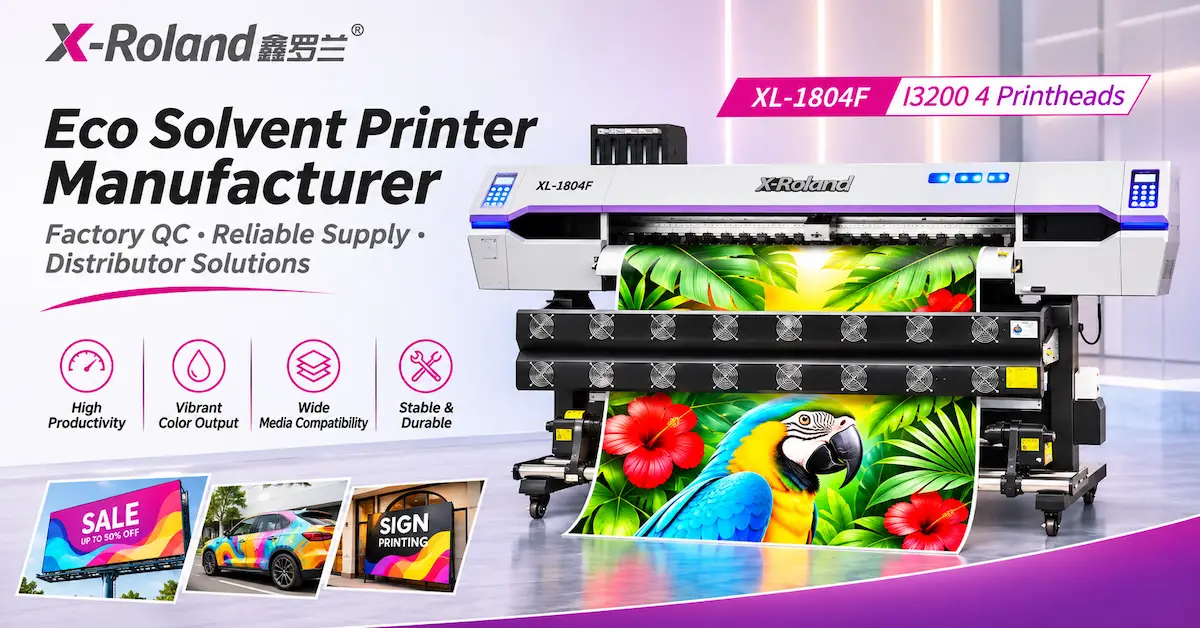
| XL-1804F | Eco-solvent configuration available | 1850 mm media | 4 × Epson I3200 | 76 m²/h |
| XL-2500Y | Eco-solvent configuration available | 2500 mm maximum print width | 2 × I3200 option | 38 m²/h |
| XL-3204Q | Eco-solvent printing | 3200 mm | 4 × Epson I3200 | 60 m²/h |
| X-Roland 3208S | Sublimation | Confirm with supplier | 8 heads; exact model to confirm | Not publicly specified |
| X-Roland 3304A | Stretch-ceiling film printing | Confirm with supplier | Confirm with supplier | Not publicly specified |
Published speeds are model-specific reference values, not a standardized comparison under identical artwork, ink, media, or environmental conditions. Confirm current specifications before purchase.
XL-1601H: Smaller Commercial Graphics Production
The XL-1601H Eco Solvent Printer lists a single Epson I3200 printhead, a 1600 mm media width, feeding and take-up equipment, and three-stage intelligent drying.
It is a candidate for print shops evaluating flexible signage, decals and display production within the approved media configuration.
XL-1804F: Multi-Head Commercial Printing
The XL-1804F Four-Head Printer lists four Epson I3200 printheads and an 1850 mm media width.
Its published configuration includes media-handling and drying features.
Buyers should verify the exact eco-solvent version because related listings also describe other ink configurations.
XL-2500Y: Intermediate Wide-Format Applications
The XL-2500Y Dual-Head Printer lists a 2500 mm maximum print width, two-head configuration options, segmented heating, continuous ink supply and a dual-motor take-up arrangement.
It may be relevant for businesses whose regular jobs exceed the practical width of narrower equipment.
XL-3204Q: Wider Advertising Production
The XL-3204Q lists a 3200 mm width and four Epson I3200 printheads.
Its published features include platform suction, media-related alarms, heating and drying, and carriage anti-collision protection.
3208S and 3304A: Specialized Application Routes
The X-Roland 3208S Sublimation Printer is listed as an eight-head textile-oriented model.
The X-Roland 3304A Stretch Ceiling Printer is listed for decorative ceiling-film printing.
Their public product pages do not provide complete numerical operating specifications. Buyers should request current technical sheets and sample testing before selecting either system.
Why Do Printhead and Ink Configurations Matter?
An industrial inkjet printer is an integrated system.
Printheads, inks, fluid delivery, electronics, RIP software, media profiles, and mechanical movement must operate together.
A machine's printhead brand alone does not establish its suitability for a particular substrate.
Epson's official I-Series product information identifies variants designed for different ink chemistries, including aqueous, UV and eco-solvent applications.
Therefore, buyers should verify the actual installed variant rather than assuming all I3200 configurations are interchangeable.
Technical Specification Checklist
| Component | What the Buyer Should Confirm |
|---|---|
| Printhead | Exact model, quantity and compatible ink |
| Ink system | Approved formulation and supply arrangement |
| RIP software | Supported software, license and profiles |
| Color management | ICC profile availability and sample approval |
| Media feeding | Roll dimensions, tension and take-up |
| Drying or curing | Required equipment and operating settings |
| Maintenance | Cleaning procedures and compatible consumables |
| Installation | Electrical requirements, ventilation and floor space |
Why Does Ink Technology Affect the Finished Product?
Eco-solvent printing uses a solvent-containing ink system and typically relies on an appropriate drying process.
UV printing uses compatible UV-curable ink and curing equipment.
Sublimation printing requires a suitable dye, substrate and fixation or transfer process.
These technologies should not be treated as interchangeable options on an existing printer unless the manufacturer explicitly supports and documents the configuration.
A manufacturer should specify the qualified complete system, not just the printhead.
How Can Buyers Calculate the Required Production Capacity?
Advertised printing speed provides a useful reference, but it is not the same as accepted commercial output.
Real production capacity depends on job setup, print mode, maintenance, loading, finishing and rejected output.
Capacity Planning Formula
Required printing rate = Monthly accepted area ÷ (Scheduled operating hours × Productive time ratio × Acceptance rate)
Consider a hypothetical print shop requiring 1,800 m² of accepted output each month.
Assume:
-
Scheduled operation: 160 hours per month
-
Productive time ratio: 65%
-
Accepted-output rate: 92%
The calculation becomes:
1,800 ÷ (160 × 0.65 × 0.92) = approximately 18.8 m²/h
The selected printer and workflow must sustain this requirement under the actual production conditions.
A model with a published four-pass speed above 18.8 m²/h is not automatically sufficient. The intended quality mode, material and workload must be tested.
Why Is Finishing Capacity Important?
A roll-fed printer may complete its output before the business can laminate, cut, inspect or pack the graphics.
The effective capacity of the production line is limited by its bottleneck.
For this reason, buyers should compare:
Accepted finished-product output per shift, rather than relying solely on printer specifications.
How Can Buyers Estimate Total Printing Costs?
Purchasing cost is only one component of equipment economics.
The relevant calculation should include consumables, labor, energy, maintenance, finishing, waste and allocated equipment expenses.
Cost per Accepted Square Meter
Cost per accepted m² = Total attributable production cost ÷ Accepted output area
Consider a hypothetical business producing 1,000 m² of acceptable finished graphics per month.
| Cost Component | Illustrative Monthly Cost |
|---|---|
| Printing media and ink | $3,000 |
| Labor, energy and finishing | $1,400 |
| Maintenance and equipment allocation | $900 |
| Additional waste and rework | $300 |
| Total | $5,600 |
Cost per accepted m² = $5,600 ÷ 1,000 = $5.60
These values are hypothetical and do not represent actual X-Roland operating expenses or quotations.
What Can Improve Profitability?
Appropriate equipment width can reduce the need for unnecessary material handling.
Reliable color profiles and tested media can reduce repeated printing.
Efficient job scheduling may improve equipment utilization.
However, the effect of each improvement depends on local labor, material costs and the actual job mix.
Commercial decision: Compare the total cost of accepted finished work, not merely the cost of ink or the printer's purchase price.
How Should Print Samples Be Approved?
Before ordering, a buyer should request samples representing actual customer work.
For example, a sign shop can submit a vinyl graphic, banner design and backlit image.
A textile business should provide its intended fabric and artwork.
Recommended Sample Approval Process
1. Prepare representative artwork. Include small text, gradients, solid colors and the most difficult graphics in the normal product range.
2. Use the intended substrate. The media and ink must match the proposed production configuration.
3. Record the print settings. Document resolution or pass mode, RIP settings, ink and media.
4. Complete the finishing process. Inspect laminated, heat-fixed, cut or applied graphics where applicable.
5. Evaluate the finished result. Review color, detail, adhesion, flexibility and handling performance against agreed requirements.
For outdoor graphics, buyers should also evaluate relevant weathering and durability requirements without assuming that every ink and media combination has the same service life.
What About Safety, Environmental Conditions and Quality Control?
Large-format printing systems can involve solvent exposure, UV curing, heated surfaces and chemical handling.
Operating requirements depend on the printing process and consumables.
The UK Health and Safety Executive's guidance for the printing industry describes the importance of controlling exposure to solvent-borne and UV-curable inks through appropriate workplace measures.
Buyers should review Safety Data Sheets and applicable local requirements for ventilation, equipment placement, operator protection and waste handling.
Equipment quality should also be evaluated through the completed printing process.
Relevant checks include:
-
Substrate feeding and tracking
-
Nozzle and registration consistency
-
Drying or curing performance
-
Repeatability across representative jobs
-
Final graphic inspection
-
Shipping and installation readiness
A supplier's general quality statement does not replace an application-specific production test.
How Can Buyers Choose a Chinese Large Format Printer Manufacturer in Three Steps?
When evaluating suppliers for large format printer manufacturer China, international buyers should verify printhead configurations, ink compatibility, sample quality, and total ownership costs rather than relying on advertised printing speeds.
Step 1: Match the Equipment to the Substrate
Action: Identify whether the main products require flexible signage printing, rigid-media printing, textile sublimation or specialty decorative-film printing.
Decision rule: Eliminate equipment that cannot support the required material and finishing workflow.
Step 2: Verify Usable Width and Production Capacity
Action: Confirm actual printable width, representative print speed, media handling, expected utilization and required finishing.
Decision rule: Select a configuration capable of producing the required accepted output with appropriate capacity allowance.
Step 3: Compare the Complete Operating Solution
Action: Request sample prints, ink and media information, software details, maintenance requirements, equipment dimensions and a comprehensive quotation.
Decision rule: Prioritize the configuration with the best verified combination of output quality, usable capacity, total cost and support.
The result should be an equipment shortlist based on real jobs, not a ranking based entirely on maximum speed.
Application Scenario: One Distributor Serving Three Printing Markets
Consider a hypothetical overseas distributor supplying equipment to three types of customer.
The distributor wants to develop a portfolio without recommending the same machine to every business.
Customer A: Local Sign Shop
The shop mainly produces decals, window graphics and smaller commercial signs.
A 1600 mm-class eco-solvent printer, such as the XL-1601H, may be worth evaluating if its verified usable width and approved media match the work.
Customer B: Wide-Format Advertising Factory
This business produces large banners and advertising graphics.
A 3200 mm-class platform, such as the XL-3204Q, may be more appropriate when wider output is required.
The distributor should validate representative speed, media handling and finishing capacity.
Customer C: Textile Printing Business
The customer produces compatible polyester textile graphics and related products.
A sublimation production route may be more suitable than an ordinary eco-solvent signage printer.
The distributor could evaluate the 3208S model after confirming its complete configuration and production process.
Commercial Result
The distributor now has three distinct equipment-selection routes linked to substrate and application requirements.
This approach can simplify product recommendations and reduce the risk of unsuitable machine purchases.
The scenario is illustrative, not a published customer case or guaranteed performance outcome.
Why Consider X-Roland for Large Format Printing Equipment?
X-Roland is associated with Guangzhou Jihui Electronic Equipment Co., Ltd., a Chinese printing equipment business established in 2013.
The company's website presents equipment for advertising, commercial printing, textiles and decorative applications.
Its published approach connects substrate assessment, equipment recommendations, sample output and production support.
The X-Roland applications overview covers signage, apparel, packaging and home décor.
Its equipment support services describe substrate and media review, color and registration checks, operator setup support, packaging guidance and after-sales response.
For overseas buyers, this creates a basis for discussing both equipment configuration and practical production requirements.
However, specific OEM/ODM customization, order quantities, lead times, certifications, warranty arrangements and technical support commitments should be verified for the selected model and purchase agreement.
What Should You Include in an RFQ?
When requesting a quotation, provide:
-
Primary application and target customer type
-
Substrate names, dimensions and thickness
-
Required finished printing width
-
Estimated daily or monthly production volume
-
Required ink technology
-
Sample artwork and quality expectations
-
Available workshop space and electrical supply
-
Destination country, order quantity and support requirements
This information makes it easier to receive an application-relevant quotation instead of a generic equipment price.
Frequently Asked Questions
1. How do I choose a reliable large format printer manufacturer in China?
Start with your intended substrates, printing dimensions and output requirements. Then verify model specifications, ink compatibility, sample quality, production capacity, maintenance requirements and written commercial terms. A suitable manufacturer should explain the complete workflow.
2. What is the difference between large-format and wide-format printers?
The terms are often used interchangeably for equipment producing graphics larger than conventional desktop printers. Actual machine dimensions, ink technologies and applications vary, so buyers should compare technical specifications rather than relying on category labels.
3. Is an eco-solvent printer suitable for outdoor signage?
Eco-solvent printing can be suitable for outdoor advertising when combined with qualified inks, compatible media and appropriate finishing. Outdoor durability must be established for the actual material system and exposure conditions.
4. When should I choose a UV flatbed printer?
A UV flatbed printer is worth evaluating when the business needs direct printing on qualified rigid materials. Confirm substrate thickness, adhesion, curing, bed dimensions and any necessary surface preparation before purchasing.
5. Is a 3.2m printer better than a 1.6m printer?
Not necessarily. A wider printer is useful when customer jobs require greater usable width. For smaller graphics, purchase cost, floor space, media handling, utilization and finishing requirements may make a narrower system more practical.
6. Does having more printheads guarantee higher productivity?
No. Printhead quantity affects potential throughput, but real production depends on print mode, mechanical design, controller performance, media, quality requirements and maintenance. Evaluate accepted output under representative conditions.
7. Can one large-format printer use eco-solvent, UV and sublimation inks?
Not automatically. These ink technologies require compatible printheads, fluid systems, substrates and processing methods. Use only configurations and conversion procedures explicitly supported by the manufacturer.
8. How much does a commercial large-format printer cost?
Prices depend on printing width, printheads, ink technology, automation, software, accessories and commercial terms. Buyers should request a complete quotation and compare total installed and operating costs rather than relying on the machine price alone.
9. Can a China manufacturer supply OEM/ODM printing equipment?
Some manufacturers offer branding or configuration cooperation. The available scope, minimum quantities, engineering changes, documentation and delivery terms must be confirmed directly for the proposed equipment.
10. What information should I send to X-Roland for an equipment recommendation?
Provide the intended materials, finished graphic sizes, required output, preferred printing technology, example artwork, installation location and estimated order quantity. Request sample verification and a model-specific technical quotation.
Conclusion
Choosing a large format printer manufacturer in China requires a clear understanding of substrates, printing technology, usable width, production capacity and total ownership costs.
For businesses researching large format printer manufacturer China, X-Roland offers commercial printing equipment options for different applications. Buyers should confirm technical specifications, sample performance, and service requirements before placing an order.
Eco-solvent, UV, sublimation and specialty printing systems serve different applications. None should be selected solely because it has a wider platform, more printheads or a higher published speed.
For print businesses, the strongest equipment investment is the system that consistently produces acceptable finished work at a commercially sustainable cost.
For overseas distributors, application-based equipment selection also provides a clearer way to serve different customer groups and develop a more focused product portfolio.
X-Roland offers a range of commercial digital printing configurations and a published equipment consultation workflow designed around customer materials and production requirements.
Looking for a large format printer manufacturer in China for your print business or distribution network? Contact X-Roland to discuss equipment selection, application samples, technical specifications and a tailored quotation. Share your materials, production targets and purchasing requirements to identify the most appropriate equipment route.