What a framed dealer certificate is really doing in a sales office
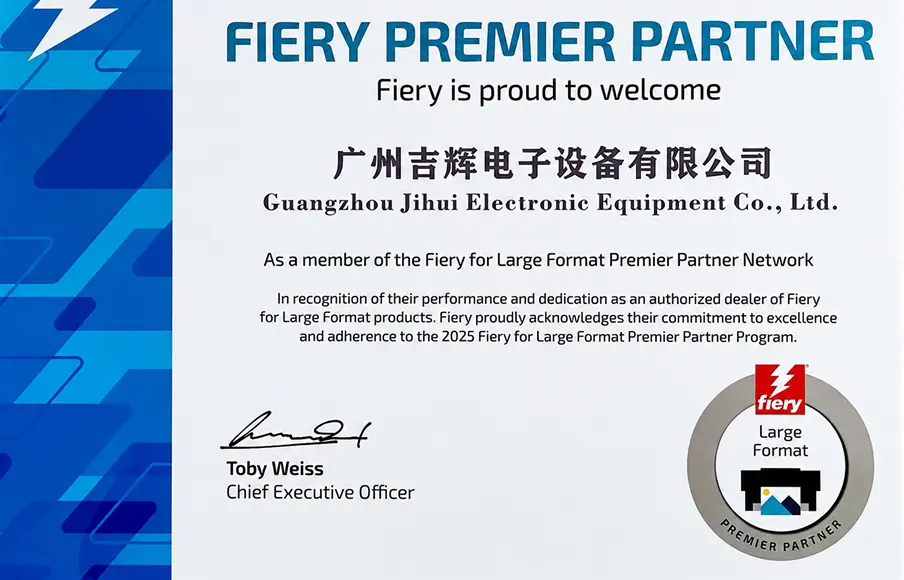
When people search for a phrase like Guangzhou Jihui Electronic Equipment Co., Ltd. signed a contract with the ... they are usually not looking for a legal document so much as a business signal. In practice, a framed printed recognition certificate or partner plaque is a visible way to show that a distributor, dealer, or service company has been formally recognized by a brand. In this case, the printed artwork identifies Guangzhou Jihui Electronic Equipment Co., Ltd. as a Fiery Premier Partner for Large Format products, with a large title, a partner badge, and signature-style presentation that is meant to be displayed rather than filed away.
That matters because in industrial equipment, buyers do not always have the time or appetite to dig through a supplier’s full history. A wall plaque, certificate, or framed recognition piece is a shorthand for trust. It does not replace due diligence, of course, but it can support a supplier’s claim that it has an established relationship with a known software or equipment ecosystem. For a showroom, reception area, or trade-show booth, that visual cue can make the first conversation easier.
Why these recognition prints matter to buyers and dealers
In many B2B sectors, especially printing, imaging, automation, and industrial equipment distribution, a formal recognition display serves several jobs at once. It reassures visiting customers. It gives the sales team something concrete to point to. It also helps separate an authorized partner from a reseller who may simply be using a brand name in marketing copy.
A plaque or framed certificate is not a technical specification sheet, and it should never be treated like one. Still, buyers often read it as a quick reference point: who was recognized, by whom, for which product line, and in what program year. In this example, the visible text references the 2025 Fiery for Large Format Premier Partner Program and a “Large Format Premier Partner” badge. That is the kind of detail that can help a procurement team or channel manager orient themselves before they ask deeper questions.
There is a practical side too. A well-made printed certificate can be moved from office to office, used in temporary event builds, or mounted in a reception wall without needing much maintenance. It is a low-complexity item, but it still needs clean typography, accurate names, and a finish that does not look flimsy under office lighting. Those are small points, yet they matter more than people admit.
What is visible in this specific partner plaque artwork
Based on the supplied description, the item appears to be a flat printed corporate recognition certificate. It features a white main field with a blue graphic side panel, a large “FIERY PREMIER PARTNER” heading, the company name “Guangzhou Jihui Electronic Equipment Co., Ltd.,” explanatory recognition text, a CEO signature, and a circular “Large Format Premier Partner” badge.
The structure suggests a piece intended for framing or direct display. No frame is visible in the image, so the final presentation could be anything from a simple mounted board to a framed document behind clear glazing. The image also points to a digital print process, likely on paper or cardstock, although the exact substrate, coating, and size are not known and should not be guessed.
For sourcing teams, that uncertainty is normal. A certificate like this is usually evaluated less like a precision part and more like a branded communication asset. The buyer cares about legibility, color accuracy, and whether the piece will hold up on a wall without curling, fading quickly, or looking cheap next to other signage.
Common production routes for this kind of certificate
Most partner plaques and recognition certificates fall into a few production paths.
Digital print on paper or cardstock
This is the simplest route and often the most economical. It works well when the design is primarily text, logos, and signature graphics. For a clean office display, the key is not just print resolution but also substrate flatness and ink stability. If the sheet waves, scuffs easily, or dulls the logo, the whole piece loses authority.
Mounted print for wall display
Some certificates are printed and then mounted to foam board, rigid board, or another backing before display. That gives the piece more presence and prevents bending. It is a practical option for reception walls and trade-show booths, although the mounting method should be chosen carefully if the plaque may be moved often.
Framed certificate presentation
A frame turns a printed certificate into a more durable office artifact. It also helps the display survive dust, fingerprints, and minor handling. The downside is weight, cost, and the risk of glare if the glazing is not selected thoughtfully. In a bright showroom, glare can hide the most important part: the company name.
How to judge a partner plaque before you order one
If you are buying a similar recognition certificate for your own dealership, showroom, or internal program, the main question is not “Does it look impressive?” It is “Will it stay credible in the room where customers make decisions?” That means checking a few practical points.
First, verify the wording. Brand names, program names, and recipient names should be accurate and consistent with the partner agreement. A tiny spelling mistake on a certificate can create more embarrassment than a mediocre design ever would.
Second, think about placement. A reception wall needs a different visual language than an internal warehouse office or a trade-show counter. A certificate that is too small disappears; one that is too busy can look like a poster. Human eyes read these objects fast.
Third, ask how it will be finished. A plain printed sheet may be enough for a file copy, but a public-facing display usually benefits from mounting, lamination, or framing. The choice depends on budget and where the item will live.
Fourth, decide whether the display needs to be updated yearly. Program-year references, such as the 2025 Fiery for Large Format Premier Partner Program noted here, can make the piece feel current. But that also means it may need replacement when the program year changes.
Common mistakes companies make with recognition displays
One mistake is treating the plaque as afterthought décor. In reality, it is part of the sales environment. If the print is cheap, crooked, or outdated, visitors notice. They may not mention it, but they notice.
Another mistake is over-designing the artwork. A certificate should not fight itself. The best ones use clear hierarchy: brand, recognition title, recipient name, and supporting badge or signature. Too many colors or effects can make it feel less official.
A more serious issue is using a certificate as proof of capabilities it does not actually confirm. A partner plaque shows recognition status, not necessarily service quality, inventory depth, or technical competence across every product line. Buyers still need to ask about support, spare parts, installation, and post-sale responsibility.
Practical buyer advice for dealers and sourcing managers
If you are commissioning a similar item, start by deciding what the object must do. If it is mainly for visual credibility, prioritize clarity and premium presentation. If it is for transport to exhibitions, prioritize durability and lightweight construction. If it is for internal recognition, you may be able to choose a simpler format and save money.
Ask for a proof before final production. That sounds obvious, but it prevents avoidable mistakes in company names, capitalization, logo placement, and signature alignment. For branded certificates, the proof is the real quality checkpoint.
Also, keep the display environment in mind. Strong sunlight, heavy glare, or a humid room can be rough on printed materials. A certificate that looks sharp in a sample photo may age badly if it is placed in the wrong spot. Small caution, but worth saying.
FAQ: quick answers about partner certificates and plaques
Is a partner certificate the same as a contract?
No. It usually indicates recognition, authorization, or membership in a partner program. It is not enough on its own to define commercial obligations.
What makes this type of plaque useful in sales spaces?
It gives customers a fast visual cue that the company has been formally recognized by a brand or program. That helps with trust and brand legitimacy.
Should the certificate be framed?
Often, yes, if it will be displayed publicly. Framing improves presentation and helps protect the print, though the final choice depends on the office style and budget.
What details matter most on the printed piece?
The recipient name, the recognition title, the program name or year, and the brand mark or badge. Those are the elements people read first.
Where this leaves the decision
A framed printed recognition certificate may look simple, but it carries real weight in industrial distribution and dealer marketing. It tells visitors who the company is, what relationship it claims, and how it wants to be seen in the market. In the case of Guangzhou Jihui Electronic Equipment Co., Ltd., the visible Fiery Premier Partner presentation is a clear example of how a printed display piece supports sales-room credibility without saying too much.
For teams choosing their own version, the decision is less about decoration than about presentation discipline. Get the wording right, choose a finish that suits the room, and make sure the display reflects the actual partnership status. If you are building a showroom wall or preparing dealer-facing materials, a clean certificate can do more work than a dozen generic banners.
If you want to evaluate or produce a similar partner plaque, start with the display purpose first, then move to print format, mounting method, and proofing. That order saves trouble later, which is usually where these small corporate pieces either succeed quietly or become an annoying reprint request.