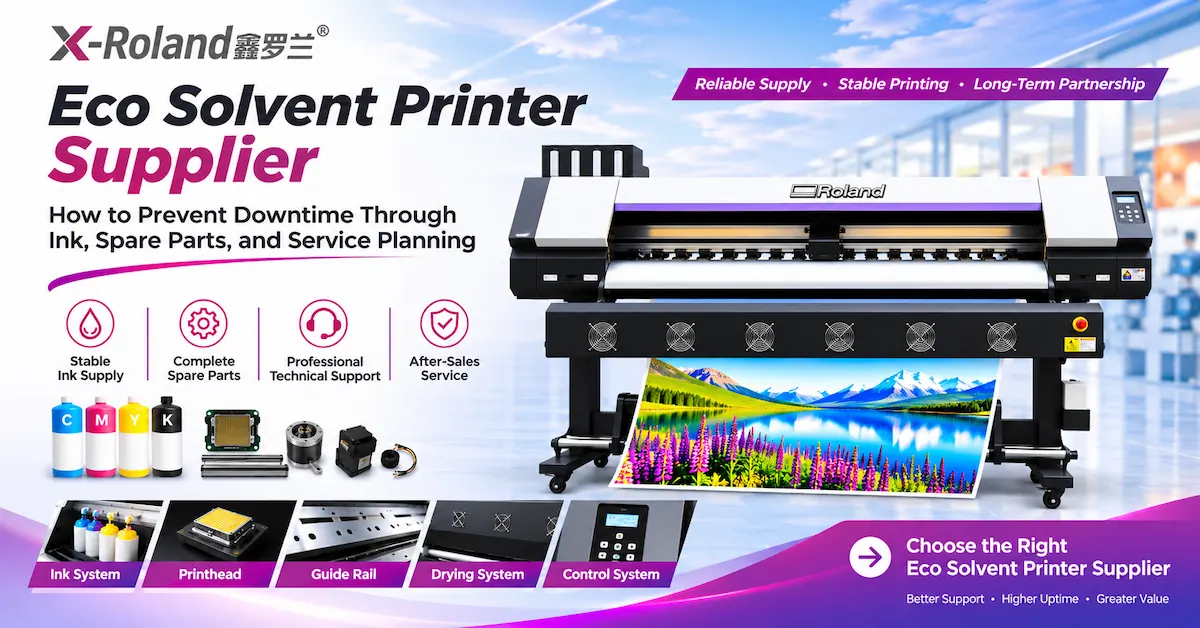
TL;DR: The right eco solvent printer supplier should help buyers maintain production after installation, not simply deliver a printing machine. For commercial sign shops and equipment distributors, supplier evaluation should include approved ink availability, spare-parts identification, remote technical support, operator training, maintenance documentation, and repeat-order planning. These factors can reduce avoidable interruptions and make long-term printing costs more predictable.
A large-format printer generates value only when it is producing acceptable customer orders.
For signage manufacturers, vehicle graphics businesses, and commercial print shops, an unexpected production interruption can affect delivery schedules, customer satisfaction, and operating margins.
Equipment-related downtime may result from printhead issues, ink shortages, feeding problems, maintenance errors, component failures, or delayed replacement parts.
These risks make supplier support an essential part of the purchasing decision.
This guide explains how to evaluate supply continuity, calculate inventory requirements, compare X-Roland eco-solvent printer configurations, and establish a practical support plan before purchasing printing equipment.
How Do Different Eco Solvent Printer Supply Arrangements Compare?
Buying from an equipment supplier is not the same as establishing a reliable long-term supply relationship.
Some arrangements focus on individual equipment transactions. Others include ongoing coordination for consumables, technical assistance, and future machine orders.
| Evaluation Factor | Transaction-Focused Supplier | Ongoing Equipment Supply Partner | Recommended Buyer Action |
|---|---|---|---|
| Equipment quotation | Primarily purchase price and specifications | Specifications plus installation and operating requirements | Request a complete equipment and accessories list |
| Ink and consumables | May provide initial supplies | Discusses compatible consumables and future replenishment | Verify ink type, supply source and reorder process |
| Spare parts | Availability may be unclear | Provides part identification and sourcing arrangements | Request model-specific parts information |
| Technical support | May be limited to initial troubleshooting | Defines available support channels and escalation | Confirm responsibilities in writing |
| Operator training | May provide basic instructions | Addresses startup, maintenance and routine production | Ask for training scope and documentation |
| Repeat orders | Specifications may be re-confirmed each time | Can maintain approved configurations and order records | Document configuration and software versions |
| Commercial risk | Potentially more uncertainty after delivery | More predictable when agreed terms are fulfilled | Evaluate the complete service arrangement |
Procurement conclusion: A lower equipment purchase price is not necessarily the most economical option if the buyer must independently solve compatibility issues, source components, or manage repeated production interruptions.
The best supplier arrangement depends on documented support capabilities, not general promises of reliability.
Key Takeaways
-
Verify consumable continuity. Approved ink and compatible media should be available when needed, not only with the original equipment order.
-
Identify critical spare parts. Confirm part numbers, availability, replacement procedures, and shipping arrangements.
-
Agree on service responsibilities. Establish how faults are reported, diagnosed, escalated, and resolved.
-
Plan maintenance before installation. Operator training and documented procedures help avoid preventable equipment problems.
-
Compare real production requirements. Select printer width and configuration around customer applications and available support.
-
Measure downtime financially. Lost contribution, material waste, repair expenses, and delayed orders belong in the ownership-cost calculation.
Why Is Supplier Support Important for Eco Solvent Printing?
An eco-solvent printer combines an inkjet printing system with media feeding, drying, electrical control, software, and maintenance components.
These systems must operate together to maintain consistent image quality.
A printer may be mechanically sound but still become unavailable because an approved ink is out of stock or the operator lacks the correct troubleshooting procedure.
Three Types of Production Interruption
1. Consumable-Related Downtime
Ink, cleaning supplies, and printing media are unavailable or incompatible with the approved production configuration.
2. Equipment-Related Downtime
A mechanical, electrical, ink-delivery, or printing component requires inspection, adjustment, or replacement.
3. Support-Related Downtime
The machine problem has been identified, but diagnosis, replacement parts, or technical assistance are delayed.
For international buyers, the third category can be particularly expensive because technical support and replacement parts may need to cross borders.
A qualified eco solvent printer supplier should be able to explain how customers can obtain help after delivery and what information is needed to initiate support.
Which Buyers Need a Long-Term Eco Solvent Printer Supply Plan?
Different customers experience different supply risks.
| Customer Type | Operating Requirement | Main Supply Risk |
|---|---|---|
| Small sign shop | Reliable daily printing | Downtime affecting most production capacity |
| Vehicle wrap business | Consistent graphics and media handling | Ink or profile changes affecting customer work |
| Commercial banner producer | Recurring wide-format output | Consumable shortages and production interruptions |
| Print equipment distributor | Supporting multiple installed printers | Spare-parts coordination and service workload |
| Regional reseller | Repeat equipment orders | Configuration inconsistency and uncertain replenishment |
A single-machine print shop may need a simple spare-parts and maintenance plan.
A distributor supporting multiple customers may require a structured inventory, technician training, serial-number records, and a defined technical escalation process.
The correct support model should reflect the number of installed machines, customer workload, available local technicians, and distance from the supplier.
Which Printer Specifications Affect Long-Term Support?
Printer selection influences more than initial output.
Media width, printhead configuration, ink delivery, drying equipment, power requirements, and mechanical arrangements affect installation, maintenance, and spare-parts planning.
X-Roland's eco-solvent printer range includes several configurations.
X-Roland Eco Solvent Printer Comparison
| Model | Listed Width | Printhead Configuration | Published 4-Pass Speed | Supply Planning Consideration |
|---|---|---|---|---|
| XL-1601H | 1600 mm media | 1 × Epson I3200 | 23 m²/h | Single-head maintenance and consumable planning |
| XL-2500Y | 2500 mm maximum print width | 2 × I3200 option | 38 m²/h | Dual-head configuration and wider media handling |
| XL-3202Q | 3200 mm width | 2 × I3200 option | 30 m²/h | Wide-format feeding, ink and maintenance requirements |
| XL-3204Q | 3200 mm width | 4 × Epson I3200 | 60 m²/h | Multiple-head configuration and greater service complexity |
| XL-3202FA | 3200 mm media | 2 × Epson I3200 | 53 m²/h | Heavier-roll handling; listed media load up to 150 kg |
These are manufacturer-published reference specifications, not standardized comparative test results. Confirm the exact model, ink configuration, usable width, software, and equipment package before ordering. Printing speeds depend on operating conditions.
XL-1601H: Commercial Printing Shops
The X-Roland XL-1601H includes one Epson I3200 printhead, a continuous ink supply system, feeding and take-up equipment, and three-stage drying.
It is worth evaluating for businesses producing commercial stickers, displays, and advertising graphics within its supported media configuration.
XL-2500Y: Wider Commercial Applications
The X-Roland XL-2500Y supports two-head configurations and lists a 2500mm maximum print width.
Its product information includes continuous ink supply, an ink-shortage alarm, segmented heating, and a dual-motor take-up arrangement.
XL-3202Q and XL-3204Q: Wide-Format Production
The XL-3202Q and XL-3204Q serve buyers evaluating wider printing platforms.
Their maintenance and inventory planning should account for the exact number and type of printheads, the ink system, and the installed media-handling components.
XL-3202FA: Heavier Media Handling
The X-Roland XL-3202FA lists a maximum media load of 150kg and combined heating and drying.
Buyers should confirm supported media dimensions and actual loading requirements before choosing this configuration.
Selection principle: Equipment capacity matters, but purchasers must also consider whether their local operation can maintain and support the selected configuration.
How Can Buyers Prevent Eco Solvent Ink Supply Interruptions?
Ink availability is a core purchasing consideration.
A large-format printer requires a qualified ink system. Buyers should not assume that any product marketed as eco-solvent ink is compatible with their equipment.
Printhead type, ink chemistry, ink-delivery components, profiles, and operating procedures must be considered together.
Ink Supplier Verification Checklist
| Requirement | Questions for the Supplier |
|---|---|
| Ink compatibility | Which ink formulation is approved for the exact printer configuration? |
| Printhead compatibility | Which printhead variant is installed? |
| Product consistency | Are batch identification and product information available? |
| Color control | Which ICC profiles and RIP settings are supported? |
| Storage | What temperature and shelf-life requirements apply? |
| Replenishment | How are repeat orders placed and confirmed? |
| Safety | Are current Safety Data Sheets available? |
| Changes | What happens if an ink formulation or supplier changes? |
Why Avoid Unapproved Ink Substitution?
Changing ink formulations without an approved procedure may affect compatibility, color output, maintenance, and equipment operation.
If a different ink system is required, obtain written compatibility and conversion instructions from the relevant equipment and ink suppliers.
Do not mix ink formulations or attempt conversions without technical authorization.
How Should Ink Replenishment Be Scheduled?
A simple inventory formula is:
Reorder point = Expected ink consumption during replenishment lead time + Safety stock
Consider a hypothetical print shop consuming an average of 0.5 liters of a particular ink per day.
If replenishment normally takes 12 days and the business maintains a 2-liter safety allowance:
Reorder point = (0.5 × 12) + 2 = 8 liters
The business should consider initiating a replenishment order when its available inventory position approaches that threshold.
This is a planning example, not a recommended universal ink stock level.
Consumption, lead times, storage limits, and supplier availability must be measured for each business.
Which Eco Solvent Printer Spare Parts Should Be Planned?
Not every part needs to be held in local inventory.
The purchasing decision should reflect component failure consequences, replacement frequency, cost, and delivery lead time.
Suggested Spare-Parts Planning Table
| Component Category | Potential Impact | Planning Approach |
|---|---|---|
| Maintenance consumables | Poor cleaning or routine maintenance interruption | Confirm routine replacement needs |
| Ink-system components | Ink delivery or maintenance problems | Identify approved replacement parts |
| Printheads | Major print quality or production interruption | Evaluate replacement cost and availability |
| Sensors and cables | Feeding or control faults | Confirm model-specific identification |
| Media-handling components | Material feeding instability | Review service and replacement procedures |
| Controller components | Equipment operation interruption | Clarify repair and technical escalation options |
| Heating and drying components | Inadequate drying or production stoppage | Confirm service procedures and spare availability |
This list represents suggested items to investigate, not a statement that X-Roland stocks every component.
What Is a Critical Spare Part?
A critical spare is a component whose unavailability could cause unacceptable operational disruption.
However, a high-cost printhead may be handled differently from an inexpensive maintenance item.
Some buyers may hold selected parts locally, while others may arrange access through their distributor or manufacturer.
Purchasing recommendation: Request a model-specific recommended spare-parts list, correct part numbers, and expected supply arrangements before placing an order.
What Maintenance Support Should an Eco Solvent Printer Supplier Provide?
Consistent maintenance practices can reduce avoidable faults and improve production predictability.
Typical areas for review include nozzle checks, ink system condition, capping and cleaning components, media-feed cleanliness, and approved startup and shutdown procedures.
Epson's SureColor S-Series maintenance documentation illustrates the importance of periodic nozzle checks, cleaning procedures, maintenance components, and proper long-term storage practices.
These instructions are specific to Epson's equipment and should not be treated as an X-Roland maintenance schedule.
The correct instructions must come from the manufacturer of the installed printer configuration.
Recommended Operator Documentation
A commercial equipment handover should clarify:
-
Printer startup and shutdown requirements.
-
Approved ink and consumables.
-
Routine nozzle-check procedures.
-
Scheduled maintenance and cleaning tasks.
-
Media loading and take-up checks.
-
Fault identification and reporting.
-
Waste ink handling and safety precautions.
-
Extended inactivity and storage procedures.
Eco-solvent printing also requires appropriate assessment of ink handling and ventilation. Buyers should follow Safety Data Sheets, equipment instructions, and applicable workplace requirements.
How Should Technical Support and Service Response Be Evaluated?
A supplier's support offering should be examined before a breakdown occurs.
The most useful arrangement defines what the buyer must report, which issues can be diagnosed remotely, and what happens when a physical replacement part is required.
Recommended Technical Escalation Process
Stage 1: Problem Documentation
The operator records the model, serial number, error messages, nozzle-check results, affected media, ink configuration, and recent operating changes.
Stage 2: Remote Diagnosis
The supplier or authorized technician reviews the evidence and provides approved troubleshooting guidance.
Stage 3: Parts or Technician Decision
If the problem cannot be resolved remotely, the parties determine whether a replacement part or onsite service is required.
Stage 4: Production Verification
After the issue is resolved, the operator checks that the printer can produce acceptable work.
Service Terms to Agree in Writing
| Service Factor | Recommended Contract Question |
|---|---|
| Support channel | Who receives technical requests? |
| Operating hours | When is assistance available? |
| Initial response | What response target can be agreed? |
| Remote assistance | What tools and procedures are supported? |
| Spare parts | Who identifies, supplies and ships replacements? |
| Warranty | Which components and labor costs are covered? |
| Escalation | What happens if the first troubleshooting step fails? |
| Documentation | Are service histories and configuration records maintained? |
Response times and repair arrangements should be negotiated and verified. They should not be assumed from a general claim of responsive after-sales service.
X-Roland describes substrate assessment, equipment recommendations, sample reviews, operator setup support, repeat-order documentation, and after-sales response within its equipment support services.
The exact service scope, warranty and response commitments should be confirmed for each purchase.
How Much Does Eco Solvent Printer Downtime Cost?
Downtime affects more than the repair bill.
A printing business may lose productive capacity, waste media, require overtime, or delay customer orders.
A practical planning formula is:
Estimated downtime impact = Unrecovered contribution lost during downtime + Direct waste + Additional recovery expenses
Example: Six Hours of Lost Production
Consider a hypothetical print shop with the following costs:
| Downtime Component | Illustrative Amount |
|---|---|
| Unrecovered contribution: 6 hours × $75/hour | $450 |
| Damaged or wasted media | $90 |
| Estimated direct impact | $540 |
This scenario excludes any additional expedited shipping, replacement parts, or customer-related expenses.
The $75 figure represents assumed contribution from productive work, not total revenue.
The example demonstrates why supplier response and parts availability should be included in equipment sourcing decisions. It is not a documented X-Roland customer result.
How Can Buyers Compare Supplier Value?
Evaluate the combined impact of purchase cost, approved ink and media costs, maintenance, expected component replacement, technical support, and production interruptions.
A lower-cost machine is not automatically less economical. Equally, a more expensive machine is not automatically more reliable.
The objective is to identify the best supported configuration for the buyer's operating requirements.
What Should a Complete Eco Solvent Printer Supplier Quotation Include?
A useful quotation should allow the buyer to evaluate the whole installed solution.
| Quotation Item | Required Clarification |
|---|---|
| Printer | Exact model, printheads and ink configuration |
| Software | RIP compatibility, licensing and included profiles |
| Consumables | Initial ink supply and approved replenishment products |
| Accessories | Drying, feeding, take-up and other included equipment |
| Spare parts | Included items and recommended additional inventory |
| Training | Available operator and maintenance instruction |
| Warranty | Coverage, exclusions and replacement procedure |
| Technical service | Available channels and responsibilities |
| Logistics | Packing, shipping terms and delivery arrangements |
| Repeat orders | Configuration records and ordering procedure |
For distributors, OEM/ODM or private-label requirements should also be addressed where relevant.
Any branding modifications, software changes, packaging arrangements, minimum order quantities, and commercial terms require direct confirmation.
How Can Buyers Select an Eco Solvent Printer Supplier in Three Steps?
Step 1: Validate the Production Requirement
Action: Identify target materials, printing widths, daily output, expected operating hours, and acceptable production interruptions.
Decision rule: Eliminate configurations that cannot produce the required work with compatible inks, media, and software.
Step 2: Validate Supply and Support Continuity
Action: Request ink compatibility information, maintenance procedures, spare-parts lists, available support channels, and repeat-order arrangements.
Decision rule: Do not approve a supplier based on equipment price alone when essential operating support remains unclear.
Step 3: Compare Long-Term Commercial Value
Action: Review the total equipment package, ongoing supplies, parts costs, service responsibilities, and downtime exposure.
Decision rule: Select the supplier with the most suitable verified combination of equipment, consumables, service, and commercial terms.
Suggested Supplier Scorecard
| Evaluation Category | Suggested Weight |
|---|---|
| Equipment suitability and print samples | 25 |
| Ink and consumable continuity | 20 |
| Spare-parts planning | 20 |
| Technical support and training | 20 |
| Total commercial costs | 15 |
| Total | 100 |
This scorecard is a proposed internal purchasing tool, not an externally certified supplier rating.
Application Scenario: A Sign Shop Preparing for Continuous Production
Consider a hypothetical commercial sign shop that uses an eco-solvent printer to produce vinyl graphics, advertising banners, and indoor signage.
Its printing orders are steady, but most large-format output depends on one machine.
The Risk
If an ink color runs out or a critical maintenance component fails, the business may have limited alternative production capacity.
Even a short interruption can affect scheduled customer deliveries.
Recommended Supply Plan
First, identify approved consumables. Record the correct ink formulation, compatible media, and approved maintenance products.
Second, establish reorder thresholds. Monitor actual consumption and replenish stock before projected usage exceeds remaining supplies.
Third, define technical escalation. Ensure the operator knows how to document a problem and obtain approved assistance.
Fourth, validate production after servicing. Use representative test graphics to confirm acceptable image quality before restarting customer orders.
Business Value
This structured process does not eliminate all breakdowns.
However, it creates a clearer basis for avoiding preventable shortages, identifying technical problems, and managing repairs.
For a distributor supporting several installations, the same approach can be adapted into a customer service program with model-specific parts records and shared technical documentation.
Why Consider X-Roland as an Eco Solvent Printer Supplier?
X-Roland is associated with Guangzhou Jihui Electronic Equipment Co., Ltd., a Chinese business specializing in the research, production, and sales of advertising printing equipment.
Its Eco Solvent Printer product category includes single-head, dual-head, and multi-head equipment for various commercial printing applications.
X-Roland's published service workflow begins with understanding customer substrates, production targets, and expected output. It also describes sample evaluation, operator setup support, and after-sales response.
For international buyers, these services provide a basis for discussing the practical requirements that follow installation.
Before purchasing, confirm the current equipment configuration, consumable compatibility, available spare parts, support responsibilities, warranty, and commercial terms.
For more general equipment-selection considerations, read X-Roland's guide to choosing an eco solvent printer and avoiding common pitfalls.
Planning a commercial equipment purchase or distributor agreement? Contact the X-Roland sales and technical team with your preferred models, applications, expected usage, and service requirements.
Frequently Asked Questions
1. How do I choose a reliable eco solvent printer supplier?
Evaluate the complete equipment configuration, sample output, ink compatibility, spare-parts arrangements, training, warranty, and after-sales responsibilities. Request written confirmation instead of relying only on advertised specifications.
2. What is the difference between an eco solvent printer supplier and a manufacturer?
A manufacturer participates in producing or assembling equipment, while a supplier may be a factory, trading company, distributor, or reseller. Buyers should identify who provides parts, training, and technical support after purchase.
3. Can I use any eco-solvent ink in my printer?
No. Ink compatibility depends on the printhead, ink system, and approved configuration. Follow the supplier's compatibility guidance and do not substitute or mix ink formulations without authorization.
4. Which spare parts should I purchase with an eco solvent printer?
Ask for a model-specific recommended inventory covering routine maintenance items and critical components. The ideal selection depends on the machine, operating intensity, part cost, and replenishment lead time.
5. How often should an eco solvent printer be maintained?
Maintenance frequency depends on the exact printer, ink system, usage, and manufacturer instructions. Follow the approved schedule and perform additional checks when print quality or operating conditions require them.
6. What should I do when an eco solvent printer stops printing correctly?
Record the error, perform only manufacturer-approved checks, and contact the appropriate technical support provider. Avoid unapproved adjustments to electrical or ink-delivery components.
7. How can I reduce eco solvent printer downtime?
Maintain approved consumable stock, follow maintenance instructions, train operators, document equipment configurations, and establish a clear support and spare-parts escalation process.
8. Is a four-head eco solvent printer better than a single-head printer?
Not universally. A four-head configuration may offer greater potential throughput, but it also changes maintenance and support requirements. Compare actual applications, accepted output, and complete operating costs.
9. Can an overseas distributor order X-Roland printers in bulk?
X-Roland offers commercial printing equipment and describes international supply and support services. Buyers should contact the company to confirm current wholesale terms, order quantities, model availability, customization options, and shipping arrangements.
10. What information should I send when requesting an eco solvent printer quotation?
Include your country, printing applications, media types, preferred width, expected daily output, required ink configuration, estimated order quantity, and technical support expectations. This helps the supplier recommend a relevant solution.
Conclusion
Choosing a reliable eco solvent printer supplier involves more than comparing machine prices, printhead quantities, or production speeds.
Long-term printing performance also depends on approved ink availability, replacement parts, operator training, maintenance procedures, and technical support.
For commercial sign shops, a well-planned supply arrangement can reduce avoidable interruptions and improve production predictability. For international equipment distributors, it can support more consistent service across multiple customer installations.
X-Roland offers several eco-solvent printer configurations and a published support workflow covering application review, sample evaluation, equipment setup, and after-sales assistance.
Before placing an order, confirm the exact machine specification, approved consumables, maintenance requirements, available spare parts, and written commercial terms.
Looking for an eco solvent printer supplier for your printing business or distribution network? Contact X-Roland to request equipment specifications, consumable recommendations, spare-parts information, and a tailored quotation. Share your production requirements and target market to begin evaluating a suitable long-term supply solution.