TL;DR: A reliable eco solvent printer manufacturer should demonstrate more than competitive equipment prices and attractive technical specifications. Overseas distributors and industrial equipment buyers should verify factory capabilities, printhead and ink compatibility, production quality control, spare-parts arrangements, export documentation, and after-sales responsibilities before placing orders. The most valuable supplier is one that supports consistent machine quality and predictable long-term ownership costs.
For international printing equipment distributors, choosing a manufacturer is a supply-chain decision, not simply a machinery purchase.
A printer may perform well during an initial demonstration but become difficult to support when replacement parts are unavailable, equipment configurations differ between shipments, or the supplier cannot provide clear troubleshooting documentation.
These problems can affect distributor profitability, customer satisfaction, and repeat business.
This sourcing guide explains how to assess an eco solvent printer factory, compare commercial equipment configurations, evaluate supplier capabilities, and reduce procurement risks when importing printing equipment from China.
How Do Eco Solvent Printer Manufacturers and Trading Suppliers Compare?
Before selecting a supplier, buyers should understand who manufactures, assembles, tests, and supports the equipment.
A factory-based manufacturer may offer direct access to production and technical teams, while a trading supplier may provide equipment from several manufacturers.
Neither business model guarantees better quality. The key is understanding who is accountable for the finished machine.
| Comparison Factor | Factory-Based Manufacturer | Trading Supplier | Buyer Verification |
|---|---|---|---|
| Equipment production | Direct manufacturing or assembly involvement | May source from external factories | Confirm actual production responsibilities |
| Configuration control | Potential direct coordination with technical teams | May depend on the original manufacturer | Request approved configuration records |
| Quality inspection | Can provide factory production and inspection evidence | May arrange independent or supplier-led inspection | Obtain machine-specific test records |
| Customization | May coordinate technical and branding changes | Depends on underlying supplier capabilities | Confirm feasibility before ordering |
| Spare parts | May support parts identification and sourcing | Often coordinates with manufacturers | Verify inventory and supply arrangements |
| Technical support | May connect buyers with equipment engineers | May provide its own service network | Define responsibility for warranty and repairs |
| Export service | May ship directly from production facilities | May consolidate products from different factories | Compare packaging, documentation and delivery terms |
Procurement conclusion: Selecting a factory does not automatically eliminate risk, but direct access to production records, configuration information, and engineering support can help distributors investigate problems and manage repeat orders.
A trustworthy supplier should be transparent about which components it manufactures and which it purchases from specialist manufacturers.
Key Takeaways
-
Verify manufacturing capabilities: Confirm the company's legal identity, production facilities, assembly activities, and final testing procedures.
-
Check configuration consistency: Printheads, ink systems, controller boards, RIP software, and mechanical components must match the approved specifications.
-
Request factory acceptance testing: Inspect print quality, media feeding, drying, safety functions, and sustained operating performance.
-
Evaluate spare-parts availability: Identify critical components and agree on replacement and technical support procedures before shipment.
-
Calculate total landed and ownership costs: Equipment price alone does not represent the full cost of importing and operating a printer.
-
Confirm export readiness: Review packaging, electrical compatibility, shipping documents, and destination-market requirements.
What Should an Eco Solvent Printer Manufacturer Be Able to Prove?
A professional eco solvent printer manufacturer should provide verifiable information about its production facilities, technical expertise, product configuration, quality-control processes, and international supply capabilities.
Guangzhou Jihui Electronic Equipment Co., Ltd., the company associated with X-Roland, was established in 2013 and operates in printing equipment research, manufacturing, and sales.
The company serves advertising, textile, and digital printing businesses through brands including X-Roland.
Its published manufacturing approach emphasizes equipment selection based on actual applications, production requirements, and sample validation.
Factory Verification Checklist
| Verification Area | Evidence Buyers Should Request |
|---|---|
| Company identity | Business registration and factory address |
| Manufacturing operations | Factory images, production videos, assembly activities |
| Technical capability | Engineering support and configuration information |
| Product consistency | Approved model specifications and component records |
| Quality control | Inspection procedures and factory test documentation |
| Export experience | Packing, shipping and customs documentation examples |
| After-sales support | Warranty terms, troubleshooting procedures and parts arrangements |
| Customization | Written confirmation of available OEM/ODM options |
These checks are particularly important when purchasing multiple machines for regional distribution.
A supplier that provides accurate records is easier to evaluate than one that relies only on marketing descriptions.
Explore X-Roland's company and manufacturing information for an overview of its factory-oriented approach.
How Does Factory Quality Control Affect Printer Reliability?
Manufacturing quality is not established by a single printing demonstration.
Industrial inkjet printers contain interconnected mechanical, electrical, fluid-delivery, and software systems.
Problems with assembly alignment, media handling, wiring, ink delivery, or calibration can affect equipment performance even when the printhead itself is functioning correctly.
Six Important Quality-Control Stages
1. Material and Component Inspection
Incoming components should be checked against purchase and assembly specifications.
For an industrial inkjet printer, relevant components can include printheads, guide rails, motors, cables, controller boards, sensors, and ink-delivery parts.
2. Mechanical Assembly and Alignment
Carriage movement, guide-rail alignment, media feeding, and mechanical clearances affect printing stability.
The manufacturer should document applicable alignment and adjustment procedures.
3. Ink System and Electrical Verification
Inspect ink connections, sensors, wiring, power requirements, and safety-related functions.
The actual verification scope should match the quoted equipment.
4. Print Calibration
Check printhead condition, registration, ink delivery, color output, and selected print modes.
5. Continuous Operation Testing
A representative production test can help identify feeding instability, recurring alarms, ink shortages, or inconsistent output.
6. Final Inspection and Packaging
Confirm the equipment configuration, accessories, test results, identification labels, packing protection, and dispatch documentation.
X-Roland publicly describes a quality-control workflow involving material checks, print calibration, production monitoring, inspection, and packing.
Buyers should request the specific inspection and test records available for their order rather than assuming that every machine undergoes an identical test duration.
Which Eco Solvent Printer Configurations Should Distributors Compare?
A major advantage of working with a manufacturer offering multiple configurations is the ability to match equipment to different customer segments.
X-Roland lists several models ranging from narrower single-head equipment to wider dual-head and four-head platforms.
X-Roland Eco Solvent Printer Comparison
| Model | Listed Width | Printhead Configuration | Published 4-Pass Speed | Potential Distributor Market |
|---|---|---|---|---|
| XL-1601H | 1600 mm media | 1 × Epson I3200 | 23 m²/h | Smaller commercial print shops |
| XL-1804F | 1850 mm media | 4 × Epson I3200 | 76 m²/h | Higher-output signage businesses |
| XL-3202Q | 3200 mm | 2 × I3200 option | 30 m²/h | Wide-format advertising producers |
| XL-3204Q | 3200 mm | 4 × I3200 | 60 m²/h | Higher-volume wide-format operations |
| XL-3202FA | 3200 mm media | 2 × I3200 | 53 m²/h | Businesses requiring heavier-roll handling |
Figures are manufacturer-published references for the listed configurations. They are not results from a standardized side-by-side performance test. Confirm actual printable width, ink system, software and media compatibility before ordering.
XL-1601H: Commercial Printing Entry Configuration
The X-Roland XL-1601H Eco Solvent Printer uses a single Epson I3200 printhead and lists 1600mm media width.
Its published features include continuous ink supply, media feeding and take-up, and three-stage drying.
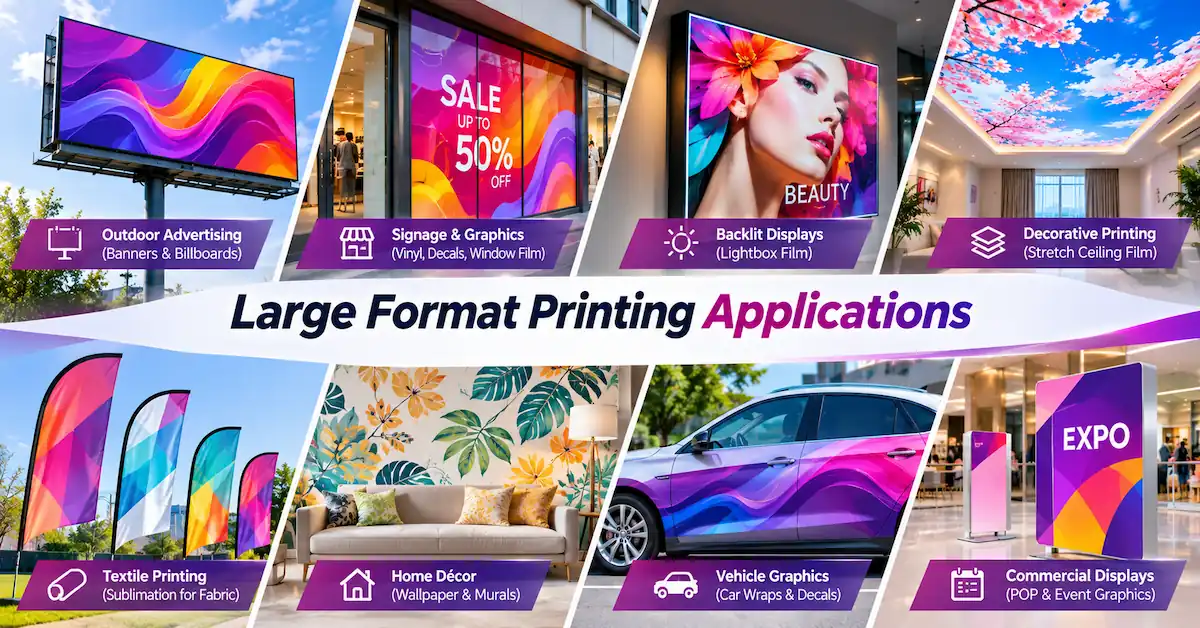
Distributors can evaluate this model for customers producing stickers, indoor displays, and smaller commercial advertising graphics.
XL-1804F: Higher-Output Graphics Production
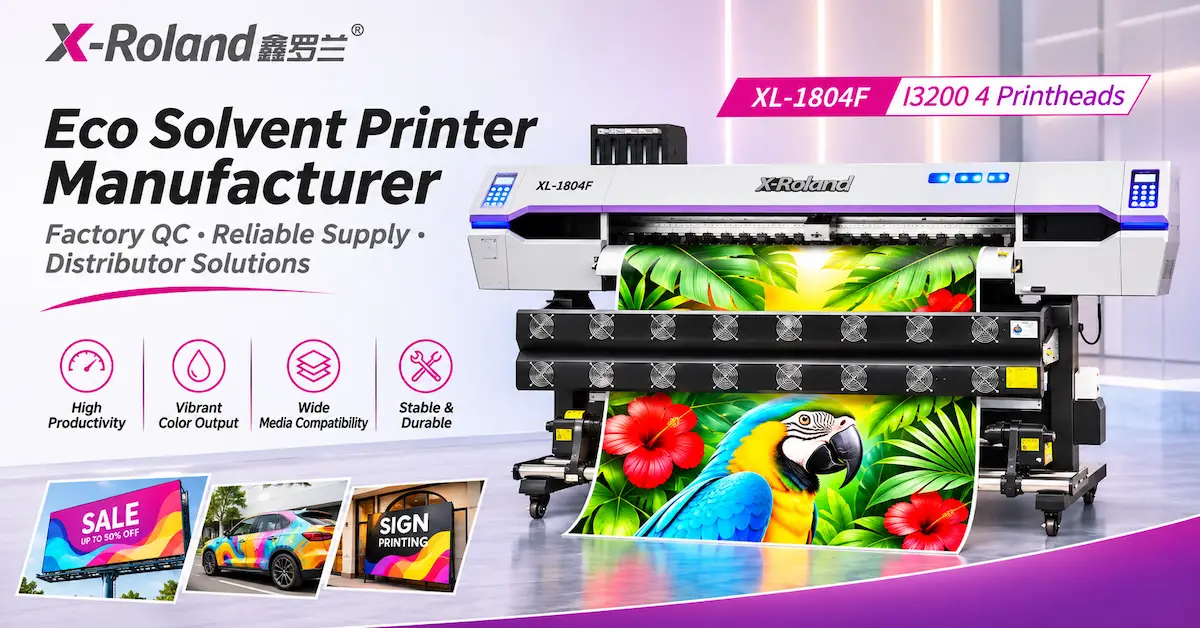
The X-Roland XL-1804F Four-Head Printer lists four Epson I3200 printheads, 1850mm media width, and integrated drying features.
It may appeal to commercial printing businesses requiring greater production throughput.
The supplier should confirm the eco-solvent configuration because related equipment listings also describe other ink systems.
XL-3202Q and XL-3204Q: Wide-Format Printer Options
The XL-3202Q Dual-Head Printer provides a 3200mm platform with I3200 or F1080 configurations.
The XL-3204Q Four-Head Printer lists four I3200 printheads and a published four-pass speed of 60m²/h.
These systems are relevant to distributors serving outdoor advertising and large-format printing businesses.
XL-3202FA: Higher Media-Load Configuration
The XL-3202FA uses two I3200 printheads and lists a maximum media load of 150kg.
This specification may be valuable for customers regularly handling heavier rolls.
However, media weight capacity does not establish compatibility with every roll diameter, material, or printing process.
Distributor recommendation: Build a portfolio around distinct customer applications rather than offering multiple models without explaining their practical differences.
Why Must Printhead and Ink Compatibility Be Verified?
Printhead technology is a major consideration in industrial inkjet equipment procurement.
Several X-Roland printers use Epson I3200 printhead configurations.
However, not every I3200 printhead variant supports the same ink chemistry.
Epson's official I Series technical documentation distinguishes printhead variants for aqueous, UV, and eco-solvent applications, including the I3200-E1 eco-solvent variant.
Technical Configuration Verification
| Component | What to Verify | Potential Risk |
|---|---|---|
| Printhead | Exact model and compatible ink variant | Incorrect ink compatibility |
| Ink supply | Approved ink and delivery configuration | Feeding instability or maintenance issues |
| Controller | Model and firmware compatibility | Equipment configuration mismatch |
| RIP software | License, profiles and supported functions | Unexpected setup or licensing costs |
| Media handling | Width, feeding, tension and take-up | Material waste or tracking problems |
| Drying system | Supported operating settings | Incomplete drying or media deformation |
| Spare parts | Correct part numbers and replacement availability | Prolonged equipment downtime |
Manufacturers should provide the exact configuration in writing.
Buyers should not assume that a printhead can be switched from aqueous to eco-solvent ink simply because the printer model is offered in multiple versions.
How Should Distributors Conduct a Factory Acceptance Test?
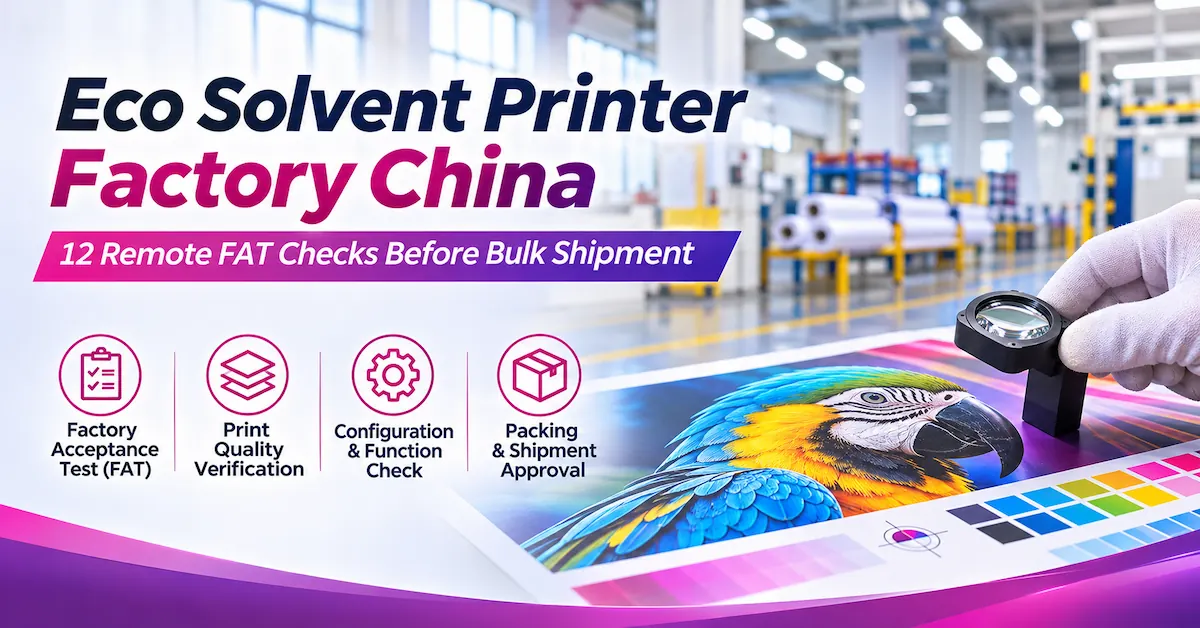
A factory acceptance test helps identify problems before machines are packed and shipped.
The test plan should be agreed upon before the purchase order is finalized.
Recommended Factory Acceptance Procedure
Step 1 — Confirm the Equipment Configuration
Check model identification, printheads, voltage, controller, ink system, software, and included accessories against the order.
Step 2 — Inspect Mechanical and Electrical Functions
Review carriage movement, media feeding, take-up, alarms, emergency-stop functions where fitted, and relevant safety protections.
Step 3 — Conduct Print Quality Tests
Use representative artwork containing fine text, solid colors, gradients, and large image areas.
Step 4 — Test Representative Media
Print on materials intended for the distributor's customers, such as suitable printable vinyl, banner media, or backlit film.
Step 5 — Verify Sustained Printing
Run an agreed production test and document time, output, alarms, material waste, and rejected prints.
Step 6 — Approve Packing and Documentation
Confirm serial numbers, accessories, spare parts, manuals, packing details, and available test records.
A factory demonstration should show the selected operating mode and actual material, not only an ideal high-speed showroom print.
Why Are Spare Parts and After-Sales Support Important?
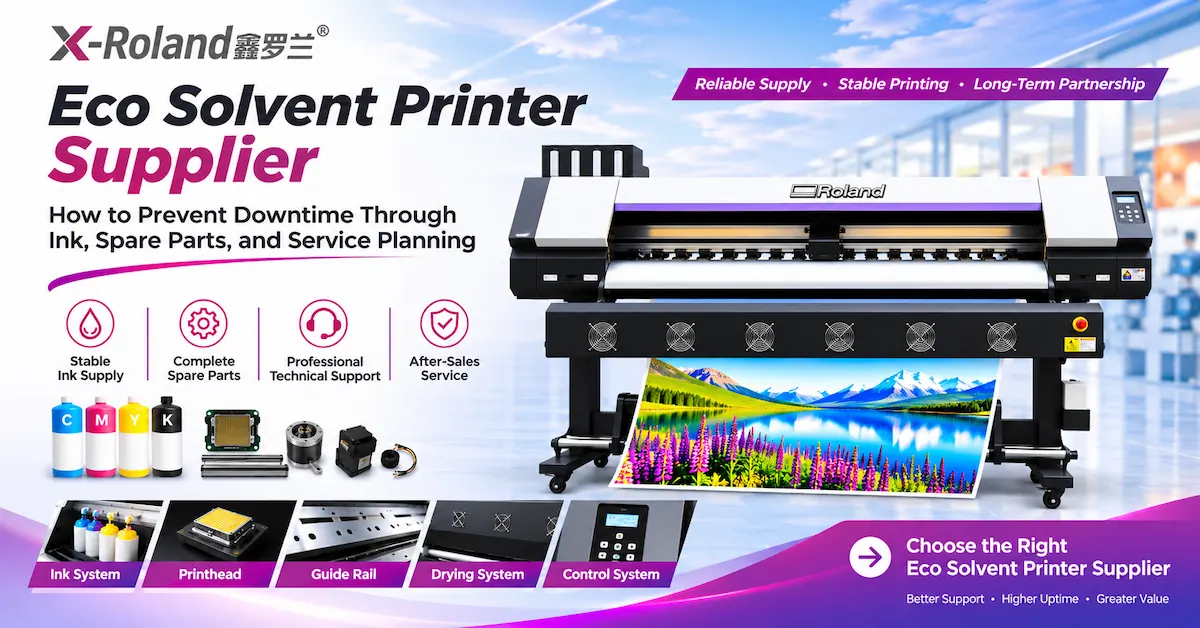
One of the largest risks for overseas distributors is being unable to resolve equipment problems after delivery.
Customers expect local distributors to assist with maintenance, troubleshooting, consumables, and replacement parts.
Before importing equipment, discuss the expected availability and ordering procedures for:
-
Printheads and related maintenance components
-
Dampers, filters and ink-system parts
-
Pumps, caps and cleaning components
-
Encoder strips, sensors and cables
-
Controller boards and electrical components
-
Heating and media-handling components
This is a suggested procurement checklist, not a claim that every listed part is stocked by X-Roland.
After-Sales Questions to Ask
Who provides the first level of technical support? Which repairs can be performed remotely? Are replacement parts available locally or shipped internationally? What warranty exclusions apply to printheads and consumables? What training is included?
These questions should be answered through written commercial and service arrangements.
X-Roland's equipment services describe operator setup support, sample review, repeat-order documentation, and after-sales response.
Specific repair response times, parts inventory, and warranty coverage must be confirmed separately.
How Much Does Importing an Eco Solvent Printer Really Cost?
The total cost of sourcing industrial printing equipment includes more than the factory quotation.
Overseas distributors should evaluate the full landed cost and expected ownership expenses.
Landed Cost Calculation
Estimated landed cost per machine = (Equipment purchase cost + freight + insurance + applicable duties and clearance costs + inland transport + allocated preparation expenses) ÷ number of machines
Consider an illustrative shipment containing ten printers.
| Cost Component | Hypothetical Amount |
|---|---|
| Equipment purchase cost | $50,000 |
| International freight | $4,000 |
| Insurance and clearance-related costs | $1,200 |
| Initial spare-parts and support allocation | $3,000 |
| Inland delivery and handling | $1,800 |
| Total estimated allocation | $60,000 |
| Allocated cost per machine | $6,000 |
This is a hypothetical example, not an X-Roland quotation. The illustration excludes any destination-specific duties or taxes not included in the stated allowances, as well as other costs that may apply.
Actual import expenses depend on the destination, shipment, customs classification, Incoterms, and applicable import rules.
A distributor should also budget for warranty servicing, local technical support, spare-parts storage, financing, and unsold inventory.
How Can Distributors Protect Their Margins?
Compare landed cost with achievable selling prices and the support responsibilities associated with each machine.
A lower initial factory price may provide little advantage if recurring service issues create substantial additional expenses.
Procurement principle: Evaluate long-term contribution after support costs rather than selecting machinery based on its purchase price alone.
What Export Documents and Compliance Information Should Buyers Request?
International machinery purchasing involves shipping, customs, installation, and destination-market requirements.
A manufacturer may be experienced in exporting equipment without every configuration automatically satisfying the requirements of every country.
Distributors should request the documents relevant to their purchase.
| Documentation | Purpose |
|---|---|
| Commercial invoice | Identifies equipment and declared transaction details |
| Packing list | Supports shipment verification and handling |
| Machine dimensions and weight | Helps plan freight and unloading |
| Electrical specifications | Supports installation planning |
| Product manuals | Provides operating and maintenance instructions |
| Test and inspection records | Supports factory acceptance |
| Applicable conformity documentation | Helps assess destination-market requirements |
| Warranty and service terms | Clarifies post-delivery responsibilities |
A CE marking, ISO certificate, or other compliance statement should not be assumed to cover every machine or destination market.
Buyers should verify document authenticity, applicable standards, equipment models, and legal requirements with qualified parties.
Environmental and operator-safety issues also require attention. The UK Health and Safety Executive's COSHH Essentials P39: Wide-Format Printing with Solvent-Based Inks describes controls for managing solvent exposure.
Eco-solvent does not mean solvent-free. Installation planning should include suitable ventilation, ink safety information, and appropriate operating procedures.
How Can Distributors Select an Eco Solvent Printer Manufacturer in Three Steps?
A structured process can reduce supplier selection errors.
Step 1: Verify Factory Identity and Manufacturing Capability
Action: Review the company's legal identity, production activities, equipment portfolio, quality procedures, and technical resources.
Decision rule: Do not approve a supplier based solely on marketing claims. Require evidence that explains who is responsible for production and equipment quality.
Step 2: Validate the Equipment and Support System
Action: Confirm model specifications, printhead and ink compatibility, production samples, factory acceptance criteria, spare parts, and service arrangements.
Decision rule: Move forward only when the proposed configuration meets documented application and support requirements.
Step 3: Compare Total Commercial Risk
Action: Evaluate quotations, landed costs, payment terms, shipment arrangements, warranty coverage, and expected operating expenses.
Decision rule: Choose the supplier offering an acceptable balance of technical capability, verifiable quality, commercial terms, and long-term support.
Practical Supplier Evaluation Scorecard
A purchasing team can use the following suggested internal scoring model.
| Evaluation Category | Suggested Weight |
|---|---|
| Product configuration and sample performance | 30 |
| Manufacturing and quality-control evidence | 20 |
| Spare parts and technical support | 20 |
| Export documentation and delivery readiness | 15 |
| Total commercial and ownership costs | 15 |
| Total | 100 |
This is a buyer-developed evaluation framework, not an externally certified supplier rating.
Application Scenario: Building a Printer Portfolio for Regional Distribution
Consider a hypothetical printing equipment distributor serving three customer groups: small sign shops, mid-sized advertising businesses, and large-format production factories.
The company wants to introduce X-Roland equipment without carrying excessive inventory or offering incompatible configurations.
Initial Purchasing Challenge
The distributor must decide which machine types to prioritize, how to prepare local service capacity, and how to support different printing applications.
Recommended Product Portfolio Approach
Small sign shops: Evaluate the XL-1601H for customers requiring a single-head, 1600mm-class roll-fed printer.
Higher-output commercial graphics: Evaluate the XL-1804F where tested production demand justifies its four-head configuration.
Wide-format advertising factories: Compare XL-3202Q, XL-3204Q and XL-3202FA based on throughput, media width, roll handling, and actual customer workloads.
Operational Priorities
Before placing a stocking order, the distributor should request approved sample prints, machine-specific specifications, a recommended spare-parts list, and documentation of operating and support requirements.
It should then determine which models can be supported by its local technicians and which configurations are commercially viable.
The business value is improved purchasing discipline: Matching equipment to customers can reduce inappropriate quotations, simplify training, and provide a clearer basis for managing inventory.
This scenario is illustrative rather than a published X-Roland customer case study.
Why Consider X-Roland as an Eco Solvent Printer Manufacturing Partner?
Guangzhou Jihui Electronic Equipment Co., Ltd. positions X-Roland as a printing equipment business connecting factory production, application requirements, and technical support.
The company publicly describes activities covering product development, production, equipment configuration, quality inspection, and international customer services.
Its Eco Solvent Printer product collection includes models with different printhead configurations, media widths, and production capabilities.
X-Roland's service approach begins by evaluating customer substrates, production targets, artwork, and required results before recommending an equipment configuration.
For distributors, the company offers a starting point for discussing equipment selection, factory testing, shipment preparation, and ongoing support responsibilities.
Specific OEM/ODM arrangements, purchasing quantities, prices, production lead times, spare-parts commitments, and warranty conditions should be confirmed in writing.
To discuss wholesale equipment requirements, contact the X-Roland team with your target market, customer applications, preferred models, and expected order quantities.
Frequently Asked Questions
1. How can I verify an eco solvent printer manufacturer in China?
Check the company's registered identity, factory address, manufacturing activities, product specifications, and quality-control evidence. Request a factory video or visit, sample printing results, and clear information about who provides technical support and warranty services.
2. What is the difference between an eco solvent printer manufacturer and a supplier?
A manufacturer is directly involved in producing or assembling equipment. A supplier may be a manufacturer, distributor, or trading business. Both can provide useful services, but buyers should identify who controls production, testing, and support.
3. Which printhead should commercial buyers choose?
The correct printhead depends on ink chemistry, printing quality, production requirements, and equipment configuration. Epson I3200 models are used in several commercial printer configurations, but buyers must verify the exact compatible variant.
4. Is a four-head eco solvent printer always more productive than a dual-head printer?
Not necessarily. Additional printheads may increase potential throughput, but actual output depends on the print mode, media, controller, machine structure, drying, and production conditions. Compare accepted output under a consistent test.
5. Can eco solvent printers produce indoor and outdoor graphics?
Yes, when the selected equipment uses compatible ink and qualified printing media. Common applications include signs, banners, decals, and vehicle graphics. Outdoor durability depends on the complete material and finishing system.
6. What should be included in factory acceptance testing?
A useful test includes configuration verification, mechanical checks, nozzle inspection, print quality, media feeding, drying, sustained operation, safety-function checks, and final accessory inspection. Acceptance criteria should be agreed upon before testing.
7. What spare parts should overseas distributors prepare?
Common items worth discussing include printhead maintenance components, ink-system parts, sensors, cables, and other model-specific service parts. The appropriate inventory depends on the machine, expected failure risks, lead times, and supplier recommendations.
8. Can X-Roland provide OEM or ODM eco solvent printing equipment?
X-Roland presents OEM/ODM cooperation as part of its broader business positioning. However, available branding, configuration changes, minimum quantities, prices, and engineering scope must be confirmed for each proposed order.
9. How can I calculate the total cost of importing eco solvent printers?
Combine equipment purchase costs with freight, insurance, applicable customs charges, inland delivery, installation preparation, spare parts, and allocated support costs. Divide the total by the number of machines to obtain a preliminary per-unit cost.
10. What should an overseas distributor include in an equipment inquiry?
Provide the destination market, expected order quantity, target customer applications, preferred printing width, ink configuration, electrical requirements, budget range, and technical support expectations. This helps the manufacturer prepare a more relevant proposal.
Conclusion
Choosing a reliable eco solvent printer manufacturer requires a structured evaluation of manufacturing capabilities, equipment configuration, quality control, export readiness, and long-term support.
For international distributors and B2B equipment buyers, low factory prices or impressive printing speeds are not sufficient reasons to approve a supplier. The more important considerations are consistent machine quality, confirmed printhead and ink compatibility, accessible technical support, and predictable total ownership costs.
X-Roland offers multiple eco-solvent printing configurations that can be evaluated for small commercial print shops, signage manufacturers, and wide-format advertising businesses. Its manufacturing-oriented approach and published service workflow provide a basis for discussing equipment requirements and sample validation.
Before placing a wholesale order, buyers should verify the selected equipment, review factory acceptance procedures, confirm shipping and service arrangements, and calculate the full commercial implications of their purchase.
Looking for an eco solvent printer manufacturer for wholesale supply or regional distribution? Contact X-Roland for equipment specifications, factory information, sample evaluation, and a tailored quotation. Share your target applications, preferred models, destination market, and expected order quantities to begin a more informed sourcing discussion.