TL;DR: Before placing a bulk order with an eco solvent printer factory China, overseas buyers should agree on technical specifications, approve representative print samples, and establish a documented factory acceptance test (FAT). A practical remote FAT checks machine identity, printhead and ink configuration, nozzle condition, print quality, media feeding, drying, operating functions, accessories, and export packing. Shipment approval should depend on recorded evidence and resolved defects—not factory videos alone.
Importing large-format printing equipment from China can help distributors and printing businesses access a wider range of configurations and production capacities.
However, the purchasing process becomes more complicated when buyers cannot visit the factory before shipment.
A product demonstration may show attractive printed graphics without proving that the equipment being shipped matches the approved specification. A sample printer may also perform differently from machines in a larger production batch.
For international distributors, these differences can create installation delays, warranty disputes, and additional costs.
This guide provides a practical remote factory acceptance method for eco-solvent printers. It explains what to inspect, how to request evidence, which X-Roland configurations to compare, and how to decide whether a machine or shipment is ready for dispatch.
Which Factory Inspection Method Provides the Most Useful Evidence?
Different verification methods answer different purchasing questions.
| Inspection Method | What It Can Verify | Main Limitation | Best Use |
|---|---|---|---|
| Factory photos and prerecorded videos | General facility and equipment appearance | May not represent the ordered machines | Initial supplier screening |
| Live factory video tour | Visible production areas and selected operations | Limited measurement and document verification | Preliminary factory review |
| Remote factory acceptance test (FAT) | Agreed machine configuration, functions and output | Depends on camera access, test scope and evidence quality | Pre-shipment equipment approval |
| Third-party inspection | Independent checks against an agreed checklist | Scope and technical expertise vary | Higher-risk or larger orders |
| Site acceptance test (SAT) | Machine performance after delivery and installation | Occurs after shipment | Final installation and operational verification |
Buying recommendation: For a first bulk order, combine approved samples, documented remote FAT results, and clear shipment acceptance criteria.
Where order value or technical risk justifies it, an independent inspector can supplement the factory's test records.
Key Takeaways
-
Approve the specification before testing. Model, ink system, printhead variant, software, voltage and accessories must be written into the order.
-
Use the buyer's artwork and media. A factory demonstration should reflect real customer applications.
-
Check serial numbers and configurations. Evidence should be traceable to the actual machines being shipped.
-
Separate appearance from functionality. Good-looking printing equipment is not proof of satisfactory output.
-
Define defect handling in advance. Record failures, corrective actions, retests and final acceptance.
-
Inspect packing after FAT approval. Shipment protection and documentation are part of the purchasing process.
What Is a Factory Acceptance Test for Eco Solvent Printers?
A factory acceptance test is a documented inspection and testing process conducted before equipment leaves the supplier's facility.
Its purpose is to determine whether the finished machine meets the requirements agreed between buyer and supplier.
FAT is different from the testing a manufacturer performs during routine assembly.
The manufacturer's internal quality checks may identify production problems, but the buyer's FAT specifically evaluates the ordered configuration against contractual acceptance criteria.
FAT vs SAT: Why Do Both Matter?
Factory Acceptance Test (FAT): Conducted before shipment to check equipment configuration, functionality and agreed output requirements.
Site Acceptance Test (SAT): Conducted after delivery and installation to verify that the machine operates acceptably at the buyer's location.
A successful FAT does not guarantee that shipping damage, incorrect installation, electrical problems or unsuitable operating conditions cannot occur later.
For industrial printing equipment, both stages help establish responsibility and reduce uncertainty.
Who Should Request a Remote FAT?
Remote acceptance testing is especially useful for:
-
Printing equipment distributors purchasing multiple machines.
-
Importers placing their first order with a Chinese factory.
-
Signage businesses purchasing wide-format production equipment.
-
Regional dealers developing an OEM/ODM equipment portfolio.
-
Companies ordering customized printing configurations.
Buyers purchasing a single low-value machine may use a simpler inspection procedure, but the core principle remains the same: verify the actual equipment before authorizing dispatch.
Which X-Roland Eco Solvent Printers Should Buyers Evaluate?
Before preparing the FAT checklist, buyers need to identify the exact machine configurations they are purchasing.
X-Roland, associated with Guangzhou Jihui Electronic Equipment Co., Ltd., offers several eco-solvent printer configurations for signage, banners, display graphics and commercial printing.
Equipment Comparison for Factory Acceptance Planning
| X-Roland Model | Listed Media Width | Printheads | Published 4-Pass Speed | Important FAT Focus |
|---|---|---|---|---|
| XL-1601H | 1600 mm | 1 × Epson I3200 | 23 m²/h | Single-head quality, feeding and drying |
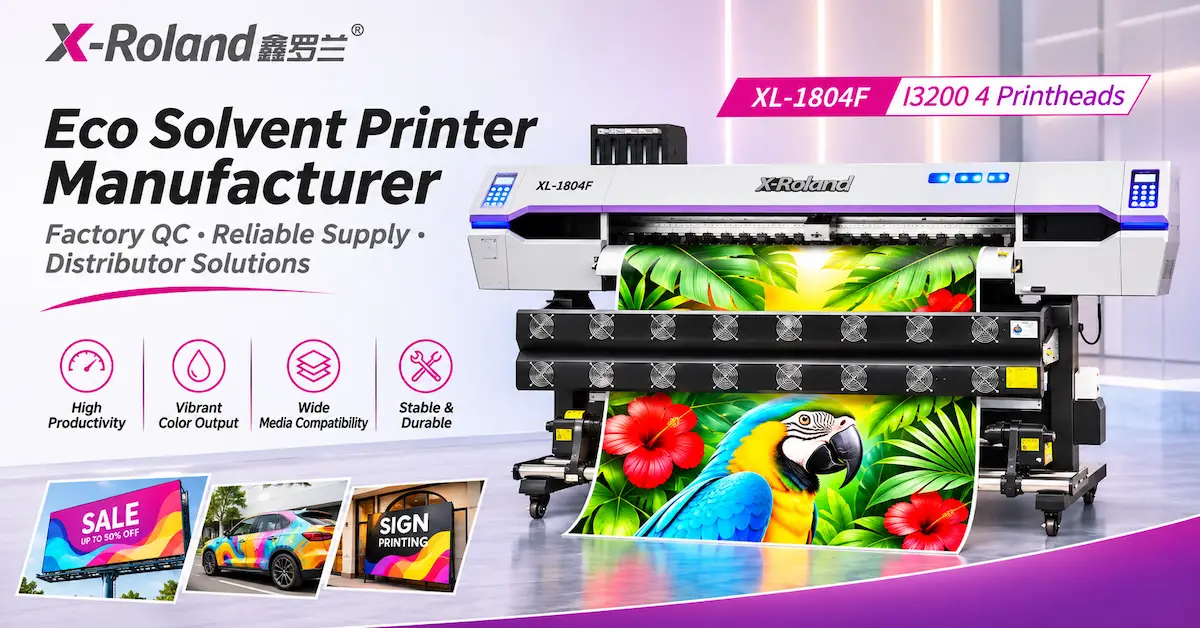
| XL-1804F | 1850 mm | 4 × Epson I3200 | 76 m²/h | Multi-head registration and sustained output |
| XL-3202Q | 3200 mm | 2 × I3200 option | 30 m²/h | Wide-media feeding and dual-head configuration |
| XL-3204Q | 3200 mm | 4 × Epson I3200 | 60 m²/h | Wide-format alignment and production stability |
These are manufacturer-published specifications for particular configurations, not comparable laboratory performance results. Actual output varies with print mode, media and artwork.
The X-Roland XL-1601H is a 1600mm-class printer with a single Epson I3200 printhead and three-stage drying.
The XL-1804F uses four I3200 printheads and lists features including adjustable pressure rollers, media-shortage detection and temperature control.
For wider applications, the XL-3202Q and XL-3204Q provide different head configurations on 3200mm platforms.
Important: The same printer family may have different ink configurations. Buyers must confirm that the equipment being supplied is the requested eco-solvent version.
For additional configurations, review the X-Roland Eco Solvent Printer collection.
What Should Be Included in the Purchase Specification?
A remote FAT becomes difficult when the original purchase order is vague.
Before manufacturing or preparing the shipment, the buyer should request a complete configuration sheet.
| Specification Item | Required Confirmation |
|---|---|
| Equipment model | Exact model and revision |
| Printhead | Manufacturer, variant and quantity |
| Ink system | Approved eco-solvent ink configuration |
| Printing width | Media and usable printing width |
| Electrical supply | Voltage, frequency and installation requirements |
| RIP software | Supported software, profiles and license terms |
| Media handling | Feed, take-up, tension and supported roll parameters |
| Heating and drying | Included equipment and adjustable functions |
| Accessories | Cables, tools, maintenance items and other included components |
| Documentation | Manuals, configuration records and warranty terms |
Epson's official I-Series documentation distinguishes printhead variants according to supported ink systems.
Therefore, a general description such as “I3200 printhead” is insufficient to establish the exact installed eco-solvent configuration.
The buyer should request the full printhead identification and approved ink information.
What Are the 12 Essential Remote FAT Checks?
The following checklist is designed for buyers sourcing commercial printing equipment from China.
Acceptance criteria should be agreed upon before the test and adapted to the selected model.
| No. | Inspection Item | Evidence to Request |
|---|---|---|
| 1 | Machine model and serial number | Identification plate and order reference |
| 2 | Printhead configuration | Installed head information and configuration record |
| 3 | Ink system compatibility | Ink specification and approved setup |
| 4 | Mechanical condition | Carriage, rails, housing and assembly inspection |
| 5 | Nozzle condition | Original nozzle-check print |
| 6 | Color and image quality | Printed buyer-approved test artwork |
| 7 | Registration and banding | Fine lines, gradients and solid-color samples |
| 8 | Media feeding and take-up | Continuous printing and feeding demonstration |
| 9 | Heating and drying | Functional operation under agreed settings |
| 10 | Alarms and protective functions | Demonstration of applicable safeguards |
| 11 | Software and communication | Job transmission and RIP configuration |
| 12 | Accessories and export packing | Packing list, accessories and crate inspection |
Checks 1–3: Confirm the Ordered Configuration
Start by comparing the physical machine with the purchase agreement.
A remote inspection should show the model identification, serial number, installed printheads and ink-system information.
Buyers should also verify that the quoted software and accessories are included.
A factory demonstration of a different model cannot substitute for evidence relating to the actual machine being shipped.
Checks 4–7: Verify Mechanical and Printing Quality
Inspect visible mechanical components and request original test prints.
The printer should complete agreed tasks without unacceptable nozzle defects, banding, registration problems or unexplained interruptions.
Color should be compared with an approved reference produced under documented conditions.
Avoid assigning arbitrary color tolerances to every printer, because acceptable variation depends on the substrate, ink, profile and application.
Checks 8–10: Test Production Functions
Run the printer using representative media.
Observe feeding, take-up, heating, drying and relevant operating functions.
Where fitted, verify applicable alarms and protective functions according to the manufacturer's safe test procedure.
A short demonstration can confirm basic functionality, but sustained production performance requires a suitably defined test duration and workload.
Checks 11–12: Confirm Handover Readiness
Verify software setup, communication, operating documents and included accessories.
After the functional tests have been approved, inspect the packing method.
A completed print sample does not establish that the machine has been correctly prepared for international shipping.
How Should Print Samples Be Tested Before Shipment?
Sample printing is a particularly important part of the FAT.
An attractive promotional image may conceal weaknesses in fine-detail printing, solid-color coverage or media handling.
Recommended Test Artwork
Use a controlled test file containing:
-
Fine black and colored text.
-
Thin horizontal and vertical lines.
-
Solid CMYK color regions.
-
Neutral gray gradients.
-
Photographic images with skin tones.
-
Large uniform backgrounds.
-
Registration patterns.
-
Artwork representative of the buyer's actual orders.
The same test files and approved settings should be used when comparing machines.
How Should Print Quality Be Evaluated?
| Quality Factor | Inspection Method | Acceptance Basis |
|---|---|---|
| Nozzle performance | Nozzle-check pattern | Agreed acceptable condition |
| Color consistency | Reference sample or measurement | Buyer-approved tolerance |
| Banding | Uniform fills and gradients | Agreed visual or measured limit |
| Registration | Fine-line test image | Model-appropriate criterion |
| Media tracking | Representative continuous print | Agreed feeding tolerance |
| Drying | Output inspection and suitable handling test | Approved ink/media process |
| Repeatability | Repeated prints under recorded settings | Consistency against approved reference |
Technical recommendation: Require the factory to record the ink, media, print mode, RIP settings and testing environment.
Without this information, comparing results between machines or production batches becomes less reliable.
How Can Overseas Buyers Conduct a Reliable Live Video FAT?
Remote inspection is more useful when the buyer controls the test sequence.
Rather than requesting a general factory video, schedule a live session around a prepared checklist.
Before the Video Session
Send the test artwork, inspection items and agreed acceptance criteria.
Ask the factory to identify the machine serial numbers to be demonstrated and confirm that the appropriate media and ink are available.
During the Video Session
Request an uninterrupted view of the machine identification followed by the relevant testing activities.
Ask the operator to show the RIP job, nozzle-check print, finished graphics and equipment controls.
Record questions and any unresolved discrepancies.
After the Video Session
Request the completed FAT report, original photographs or recordings, configuration sheets and corrective-action records.
A live video is useful evidence, but it cannot independently verify every hidden component or electrical measurement.
For high-value orders, buyers may supplement remote FAT with an appropriately qualified independent inspection.
How Should Multiple Printers Be Inspected in One Bulk Order?
A successful sample machine does not prove that every machine in a shipment has the same configuration or performance.
When purchasing multiple units, the buyer should identify how the factory's own checks and the buyer's acceptance sampling will work together.
Recommended Lot Inspection Approach
Machine identity: Verify that every unit in the shipment is recorded with the correct model and serial number.
Configuration: Check model-specific information and approved component configurations.
Functional testing: Obtain factory test records for each unit according to the agreed inspection plan.
Witness testing: Select machines for detailed buyer or third-party observation.
Defect management: Record discrepancies by affected serial number.
The sampling plan should reflect order size, equipment value and risk.
AQL-based inspection may be useful for certain attributes when correctly specified, but a sampled inspection should not be presented as a guarantee that every machine is free from defects.
For critical safety or identity requirements, the buyer may require checks across all units.
How Should Factory Test Failures Be Handled?
Discovering a problem during FAT is not automatically a reason to cancel the entire order.
The important question is whether the discrepancy can be documented, corrected and retested before shipment.
Suggested Defect Classification
| Defect Type | Illustrative Example | Recommended Action |
|---|---|---|
| Critical | Serious safety hazard or materially incorrect essential configuration | Do not release the affected equipment |
| Major | Unacceptable print quality or failed essential function | Correct and retest before approval |
| Minor | Cosmetic or documentation issue that does not impair agreed function | Record and resolve according to agreed terms |
These categories are suggested purchasing definitions, not automatic classifications under a particular inspection standard.
Corrective Action Procedure
-
Record the issue and affected machine serial number.
-
Compare the result against the agreed acceptance criterion.
-
Ask the supplier to identify and correct the cause.
-
Repeat the relevant test.
-
Document the result and buyer approval.
-
Authorize packing only when contractual release conditions are met.
Buyers should avoid relying on verbal confirmation that a problem has been fixed.
What Export Packing Details Should Be Checked?
Shipment protection is especially important for wide-format printers because they contain sensitive mechanical assemblies and precision printing components.
Before approving dispatch, review the proposed packing method.
Pre-Shipment Packing Checklist
| Packing Item | What to Verify |
|---|---|
| Machine identification | Model and serial number match shipping records |
| Transport restraints | Manufacturer-specified carriage and moving-part protection |
| Ink system preparation | Approved procedure for shipment and storage |
| External protection | Suitable protection against handling damage |
| Crate or packaging | Appropriate construction for the selected freight method |
| Accessories | Components match the approved packing list |
| Documentation | Manuals, packing list and relevant shipping documents |
| Dimensions and weight | Actual shipping information is recorded |
Whether components need to be removed, secured or prepared for transport depends on the exact machine.
Buyers should follow the manufacturer's shipping instructions rather than improvising protection methods.
Destination-market electrical, conformity and customs requirements should also be checked separately. A successful FAT is not a substitute for legally required documentation.
How Much Can Pre-Shipment Inspection Risk Cost?
The value of FAT is not that it guarantees a defect-free shipment.
Its value is identifying certain problems while the machine is still accessible to the factory.
Consider a hypothetical equipment importer that discovers an incorrect printer configuration after delivery.
| Additional Cost | Illustrative Amount |
|---|---|
| Replacement component and shipping | $350 |
| Local technician visit | $180 |
| Additional handling and coordination | $120 |
| Total additional direct expense | $650 |
These values are illustrative, not X-Roland service prices or actual customer data.
The scenario excludes potential lost customer sales, installation delays or other commercial consequences.
If a buyer can identify the configuration discrepancy before shipment, the problem may be easier to address at the factory.
However, the cost of inspection itself should also be included in the purchasing decision.
What Should Buyers Ask About OEM/ODM and Repeat Orders?
For distributors, the first successful shipment should create a reproducible equipment specification.
If future orders involve different branding, machine accessories or software configurations, the approved changes should be documented.
Request confirmation of:
-
Available OEM/ODM configuration options.
-
Model and version control.
-
Approved branding and packaging details.
-
Component-change notification procedures.
-
Machine serial-number records.
-
Repeat-order specification consistency.
-
Minimum order quantities and commercial terms.
Do not assume that every customization is available for every model.
X-Roland's services information describes substrate assessment, sample evaluation, setup support, packing guidance and repeat-order documentation.
Specific customization terms and inspection arrangements must be confirmed through the purchasing agreement.
How Can Buyers Approve a China Factory Shipment in Three Steps?
Step 1: Approve the Specification and Reference Samples
Action: Confirm the model, printhead, ink system, media, RIP software, accessories and buyer-approved test artwork.
Decision rule: Do not begin final acceptance until the equipment specification and performance criteria are sufficiently clear.
Step 2: Complete FAT and Resolve Discrepancies
Action: Review machine-specific records, witness the agreed tests, evaluate samples and obtain corrective-action evidence.
Decision rule: Hold approval for units with unresolved failures against essential acceptance criteria.
Step 3: Verify Packing and Authorize Dispatch
Action: Confirm serial numbers, accessories, transport preparation, packing and required shipping documents.
Decision rule: Authorize shipment only according to the agreed contractual release requirements.
This three-stage process provides an auditable trail from the purchase order to the actual delivered equipment.
Application Scenario: First Bulk Order From a Chinese Printer Factory
Consider a hypothetical overseas distributor preparing its first order of six commercial eco-solvent printers.
The distributor wants to supply regional sign shops and cannot attend the factory in person.
Purchasing Challenge
The buyer must confirm that the ordered models have the correct eco-solvent configurations, produce acceptable graphics, and arrive with the agreed accessories.
Proposed Acceptance Plan
First: Create an approved configuration sheet and reference artwork for each model.
Second: Ask the factory to provide model and serial-number records for the six machines.
Third: Arrange the agreed functional testing and a live remote FAT for selected units.
Fourth: Review any discrepancies and require documented retesting.
Fifth: Verify the packing records before authorizing dispatch.
Expected Business Value
This method helps the distributor establish clearer equipment acceptance requirements, reduce ambiguity when discussing problems, and create a consistent process for repeat orders.
It does not guarantee that shipping damage or future failures will be eliminated.
This example is a recommended purchasing workflow, not a documented X-Roland customer case.
Why Consider X-Roland for Eco Solvent Printer Factory Sourcing?
X-Roland is associated with Guangzhou Jihui Electronic Equipment Co., Ltd., a Chinese printing equipment business established in 2013.
Its public website describes activities involving equipment research, production, sales, quality checkpoints and international customer support.
The company's About page outlines a workflow covering customer requirements, material checks, print calibration, production monitoring, inspection and dispatch.
Its eco-solvent printer portfolio includes single-head, dual-head and four-head configurations for commercial graphics applications.
For first-time overseas buyers, this provides a starting point for discussing model selection, sample approval, factory testing and shipment preparation.
However, the exact FAT scope, inspection evidence, third-party inspection permissions, lead times and commercial commitments should be negotiated before ordering.
Planning an import order? Contact X-Roland with your target models, order quantity, destination country and intended printing materials to request technical specifications and discuss a suitable acceptance process.
Frequently Asked Questions
1. How do I verify an eco solvent printer factory in China remotely?
Request company registration information, factory details, model-specific specifications, sample prints and a live demonstration. Use written acceptance criteria and trace test results to the actual machines being purchased.
2. What is an FAT for an eco solvent printer?
FAT stands for Factory Acceptance Test. It is a documented procedure conducted before shipment to determine whether the equipment meets agreed technical and functional requirements.
3. Is a factory video enough to approve a printer shipment?
A general factory video is insufficient for comprehensive equipment approval. A structured live test, serial-number verification, print samples and documented inspection results provide more relevant evidence.
4. What printing samples should buyers request?
Use test artwork containing fine text, solid colors, gradients, registration patterns and representative customer images. Print on compatible media using documented production settings.
5. Should every printer in a bulk order be tested?
The factory's test coverage and the buyer's acceptance sampling should be agreed upon. Essential identity and safety-related checks may require broader verification than selected performance tests.
6. Can I3200 printheads use different ink types?
Different Epson I3200 variants support different ink systems. Buyers must confirm the exact installed variant and approved ink configuration rather than assuming all I3200 printheads are interchangeable.
7. What happens if a printer fails the FAT?
Record the failure, request corrective action and repeat the relevant test. Shipment approval should follow the agreed acceptance criteria and contract terms.
8. Is FAT the same as installation testing?
No. FAT is conducted before shipment at the supplier's facility, while SAT verifies equipment after delivery and installation at the buyer's site.
9. Can I request a third-party inspection before shipment?
Buyers can propose an independent inspection as part of the purchase agreement. Confirm inspection access, scope, timing, cost and reporting responsibilities before placing the order.
10. What should I include in an eco solvent printer factory China inquiry?
Specify your destination country, target application, printing width, preferred model, ink configuration, order quantity, software requirements, sample artwork, FAT expectations and shipment terms.
Conclusion
Sourcing from an eco solvent printer factory China can provide overseas buyers with access to different machine configurations and commercial printing capabilities.
However, a reliable purchasing decision depends on more than factory photos, advertised speeds or the initial quotation.
A structured remote factory acceptance test helps buyers verify equipment identity, printhead and ink configuration, sample quality, operating functions, accessories and shipment preparation before dispatch.
The most effective approach is to define requirements early, collect traceable evidence and resolve significant discrepancies before releasing the order.
X-Roland offers a range of eco-solvent printing equipment and publicly describes factory quality checkpoints, sample evaluation and international customer services.
Looking to purchase eco-solvent printers directly from China? Contact X-Roland for current model specifications, sample testing options and a bulk-order quotation. Include your target applications, selected configurations, order quantity and inspection requirements so the team can assess your project.