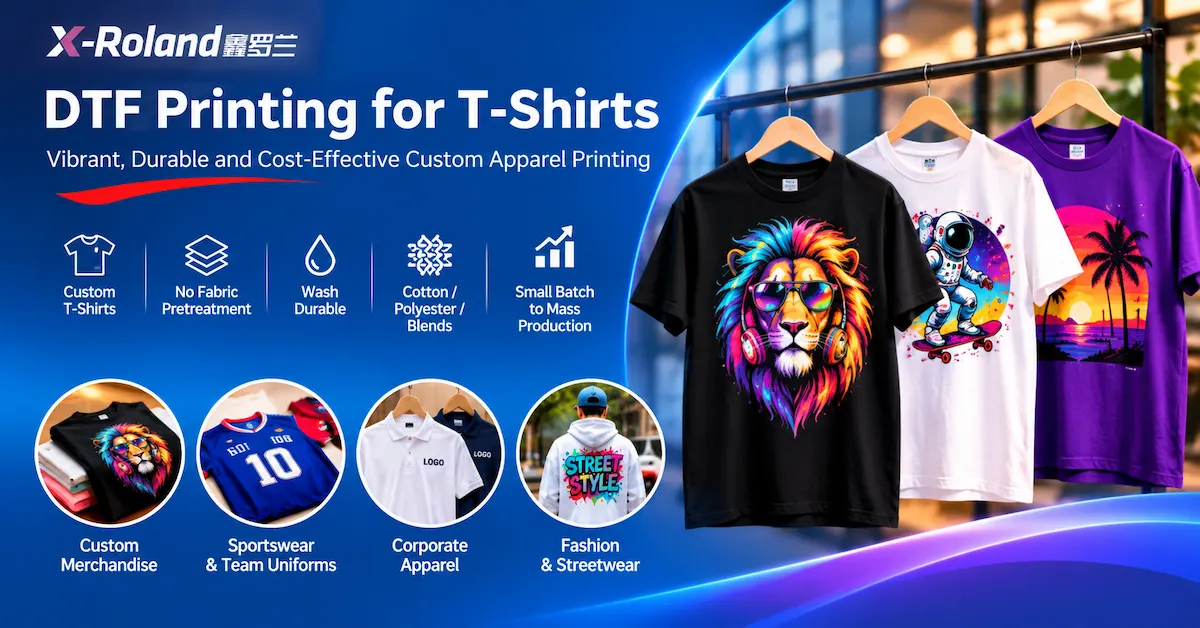
TL;DR: A commercial DTF printing machine for t shirts should be evaluated by white ink stability, adhesive powder coverage, curing consistency, heat-press performance, wash durability, and cost per accepted garment. Manual DTF systems are worth considering for smaller orders, while integrated roll-to-roll systems can support recurring production. The best investment is the workflow that produces repeatable, wash-resistant transfers at a sustainable cost—not necessarily the printer with the highest advertised speed.
For apparel manufacturers, custom T-shirt businesses, and print-on-demand suppliers, choosing DTF equipment involves balancing print quality, production capacity, garment compatibility, and long-term operating expenses.
A transfer can look visually attractive immediately after heat pressing but develop peeling, cracking, or adhesion problems after washing. These failures may originate from inconsistent white ink, insufficient adhesive powder, incorrect curing, or unsuitable pressing conditions.
This technical buying guide compares DTF production workflows across four critical criteria, explains the main quality-control requirements, and provides practical costing formulas and a three-step purchasing checklist.
How Do DTF T-Shirt Printing Systems Compare Side by Side?
Before purchasing equipment, apparel businesses should compare the complete production workflow rather than focusing solely on the printer.
| Comparison Dimension | Manual DTF Workflow | Integrated Roll-to-Roll DTF System | Best Fit / Decision Rule |
|---|---|---|---|
| Production Volume | Suitable for smaller batches and design testing | Worth evaluating for recurring commercial orders | Base the choice on accepted garments per shift |
| Powder Application | Manual or separate powdering process | Compatible automatic powder shaker | Automated processing is more relevant when consistency and throughput become limiting factors |
| Curing & Handling | Separate suitable curing equipment | Inline or connected curing arrangement | Compare processing control, safety and operator workload |
| Investment & Operating Costs | Configuration-dependent entry investment; more manual handling | More equipment integration and maintenance requirements | Calculate total ownership cost and finished-shirt contribution |
For businesses with irregular orders, purchasing preprinted DTF transfers from an external supplier is another option that avoids immediately investing in printing equipment.
Technical conclusion: Manual production can provide operational flexibility, while integrated systems may reduce repetitive handling when the company has sufficient demand. However, automation does not eliminate the need for material validation and quality inspection.
Buyers can review the X-Roland DTF printing solutions category when planning commercial apparel printing equipment.
Key Takeaways
-
Prioritize white ink stability: Consistent white coverage affects image opacity, powder adhesion, and finished transfer quality.
-
Control adhesive powder application: Incomplete coverage can weaken bonding, while excess powder may create unwanted adhesive halos and stiff graphics.
-
Validate curing and heat pressing separately: Both processes require suitable time, temperature, and handling conditions.
-
Evaluate real wash durability: Visual inspection immediately after transfer is insufficient for commercial product approval.
-
Calculate cost per accepted shirt: Include ink, film, adhesive, labor, energy, garment blanks, maintenance, and rejected output.
-
Compare complete equipment configurations: Confirm what the quotation includes, especially powdering, curing, RIP software, and heat pressing.
The Process Behind the Numbers: DTF Production Evaluation Method
DTF printing combines digital inkjet printing with adhesive powder bonding and heat transfer.
The finished result depends on several interconnected variables, including the printable film, white and colored inks, adhesive powder, curing process, garment surface, and heat-press conditions.
Epson's DTF Film Printing Guide describes a sequence involving film printing, powder application, thermal processing, and heat transfer. It also emphasizes removing excess adhesive powder and preventing loose powder from entering the printer.
DuPont's Artistri DTF-120 Transfer Film technical data sheet provides additional guidance on powder coverage, curing, heat pressing, and transfer-film release.
These publications establish useful technical principles, but their specific operating parameters cannot automatically be applied to every machine or consumable combination.
Evaluation Criteria for Commercial Equipment
| Technical Parameter | What to Evaluate | Commercial Importance |
|---|---|---|
| White Ink Performance | Opacity, nozzle condition, ink management | Stable graphics and consistent transfers |
| Film Compatibility | Coating, feeding, release method | Reduced production defects |
| Powder Coverage | Distribution and excess removal | Transfer adhesion and hand feel |
| Curing Control | Suitable time and temperature | Reliable adhesive preparation |
| Heat Press Uniformity | Temperature, pressure and contact | Consistent garment bonding |
| Wash Performance | Adhesion, cracking, color retention | Product durability |
| Production Yield | Accepted garments and rejected units | Cost and profitability |
Evaluation principle: The correct equipment should be selected through a repeatable test using the buyer's actual garments, artwork, and intended consumables.
Why Is White Ink Management Critical for DTF T-Shirt Printing?
White ink is an important part of conventional full-color DTF transfer workflows.
It provides opacity when graphics are applied to dark fabrics and contributes to the printed layer that receives the hot-melt adhesive powder.
For commercial apparel businesses, poor white ink performance can reduce transfer consistency and increase maintenance-related interruptions.
Common White Ink Problems
Nozzle blockage: White ink systems may require appropriate circulation, agitation, cleaning, and maintenance to manage sedimentation and nozzle health.
Uneven opacity: Inconsistent white deposition can produce color variation or poor coverage on dark garments.
Incorrect layer registration: Misalignment between color and white layers can create visible white outlines.
Excessive or insufficient coverage: Incorrect ink deposition may influence image appearance, powder bonding, and finished print feel.
How Should Buyers Evaluate White Ink Performance?
Request a demonstration using fine text, solid-color artwork, gradients, and designs intended for black T-shirts.
Inspect the transfer before and after pressing.
Also ask the equipment supplier to explain the actual white ink maintenance process, nozzle-check procedure, compatible inks, and expected consumable requirements.
Buying recommendation: Do not assume a particular printhead count guarantees better white ink performance. The ink system, controller, software, print mode, and maintenance arrangements must work together.
How Does Adhesive Powder Affect DTF Wash Durability?
Adhesive powder helps bond the printed design to the garment during heat transfer.
Coverage consistency is therefore a major factor in finished-product durability.
Insufficient Powder Coverage
When portions of the printed image receive too little adhesive, those areas may bond poorly to the fabric.
The result can include incomplete transfer, lifting edges, or deterioration during washing.
Excessive Powder Application
Excess powder outside the intended design can create unwanted adhesive marks or halos.
Heavy powder deposits may also produce an unnecessarily stiff finished print.
DuPont's DTF-120 film technical guidance specifically highlights the importance of complete image coverage and removing excess powder.
Powder Application Quality Checklist
-
Confirm the adhesive powder is compatible with the selected ink and film.
-
Check that powder covers the intended printed areas.
-
Remove excess powder from unprinted regions.
-
Inspect for clumping or uneven distribution.
-
Verify the processed transfer before heat pressing.
For higher-volume operations, a compatible automatic powder shaker may help organize the powdering workflow. However, buyers must verify its actual operating performance and dust-control arrangements.
What Curing and Heat-Press Conditions Prevent Transfer Failure?
Curing and heat pressing perform different functions in the DTF workflow.
During curing, the adhesive powder is thermally processed on the printed film.
During heat pressing, the prepared transfer is bonded to the garment.
Incorrect conditions in either stage can affect transfer completeness and durability.
Powder Curing Requirements
The appropriate curing conditions depend on the adhesive powder, ink, transfer film, and equipment.
Insufficient processing may leave the adhesive inadequately prepared. Incorrect or excessive heat may damage materials or affect transfer behavior.
DuPont's DTF-120 technical documentation describes example oven processing temperatures of 135–160°C for certain short-duration curing arrangements.
These values are product-specific technical references, not universal settings.
Heat-Press Requirements
The heat press must provide suitable contact, temperature, pressure, and dwell time.
For its DTF-120 film system, DuPont describes a transfer range of 150–170°C for approximately 8–15 seconds under specified processing conditions.
Other films, powders, inks, and garments may require different settings.
Important: Always follow the current instructions for the qualified consumables and equipment combination.
Common Processing Defects
| Defect | Possible Cause | Corrective Check |
|---|---|---|
| Incomplete transfer | Incorrect pressing or adhesive processing | Verify approved press and curing conditions |
| Edge peeling | Inadequate adhesive coverage or bonding | Inspect powder and platen contact |
| Adhesive halo | Excess powder outside printed areas | Improve powder removal |
| Fabric damage | Excess heat or unsuitable garment | Test actual fabric and processing conditions |
| Uneven adhesion | Inconsistent temperature or pressure | Check heat-press uniformity |
| Incorrect film release | Wrong peel timing or incompatible film | Follow film-specific hot/cold peel instructions |
How Can Manufacturers Verify DTF Wash Durability?
Wash testing is one of the most valuable steps in commercial T-shirt production.
A successful transfer immediately after pressing does not guarantee that the graphic will remain acceptable after repeated laundering.
Recommended Wash-Durability Evaluation
Step 1 — Prepare representative samples. Use actual customer garments, including dark cotton, polyester, and blended materials where relevant.
Step 2 — Record processing conditions. Document the ink, film, powder, printing settings, curing conditions, heat-press settings, and peel method.
Step 3 — Inspect the initial garment. Record edge adhesion, image appearance, flexibility, and visible defects.
Step 4 — Conduct controlled laundering. Use an agreed washing method, detergent, temperature, and number of cycles.
Step 5 — Compare the results. Evaluate color changes, cracking, edge lifting, and adhesive performance.
For commercial uniforms or applications requiring documented performance, buyers may request appropriate standardized textile testing.
Avoid promising a specific wash-cycle lifespan without corresponding test evidence.
Quality decision: Accept the production configuration only when its finished garments meet the buyer's defined durability and appearance requirements.
How Much Does DTF Printing Cost per T-Shirt?
The operating cost of a DTF printing machine for t shirts should be measured against accepted finished products rather than printing area alone.
A complete calculation includes:
-
Blank garments
-
DTF transfer film
-
CMYK and white inks
-
Adhesive powder
-
Curing and heat-press energy
-
Production labor
-
Equipment maintenance
-
Packaging and rejected garments
Example: Cost of a 500-Shirt Production Batch
Consider the following hypothetical production scenario.
| Production Cost | Illustrative Amount |
|---|---|
| Blank T-shirts | $1,250 |
| DTF film and ink | $360 |
| Adhesive powder | $75 |
| Labor and energy | $350 |
| Maintenance, packaging and other allocations | $215 |
| Total Batch Cost | $2,250 |
Assume 500 garments are attempted and 475 pass final quality inspection.
The accepted production rate is:
475 ÷ 500 × 100 = 95%
Cost per accepted T-shirt:
$2,250 ÷ 475 = $4.74 per shirt
If the accepted garments sell at an average price of $8 each, the illustrative difference is approximately $3.26 per shirt before any additional expenses excluded from the model.
These figures are hypothetical and should not be interpreted as X-Roland machine performance, equipment prices, or actual customer results.
Why Does the Acceptance Rate Matter?
Rejected shirts consume materials, ink, adhesive, processing time, and labor without generating normal saleable output.
A production improvement that reduces rejects can therefore be valuable even when printer speed remains unchanged.
For this reason, buyers should request data on accepted production output rather than evaluating printing speed alone.
How Does Production Volume Determine the Right DTF Equipment?
As production volume increases, the main challenge shifts from processing individual transfers to coordinating the complete production line.
The printer, powder shaker, curing equipment, heat press, and inspection process must operate at compatible rates.
DTF Production Scale Comparison
| Business Stage | Potential Production Route | Main Purchasing Priority |
|---|---|---|
| Startup / irregular orders | Outsourced transfers or controlled manual DTF workflow | Avoid excessive initial investment |
| Growing custom T-shirt shop | Manual or partially automated DTF production | Reduce handling errors and improve repeatability |
| Established garment decorator | Evaluate integrated roll-to-roll DTF workflow | Coordinate powdering, curing and pressing |
| Wholesale transfer manufacturer | Higher-throughput integrated production, subject to testing | Accepted output and production stability |
These categories are qualitative guidance rather than universal production-volume thresholds.
Calculate Required Production Capacity
A practical planning formula is:
Required attempted output per productive hour = Daily accepted-shirt target ÷ (Scheduled hours × Productive time ratio × Acceptance rate)
Suppose a business needs 120 accepted shirts per day, operates an eight-hour shift, uses 70% of scheduled time productively, and achieves a 95% acceptance rate.
120 ÷ (8 × 0.70 × 0.95) ≈ 22.6 shirts per productive hour
The entire production line must demonstrate the ability to maintain this output.
A printer's maximum printing speed cannot establish finished-garment capacity by itself.
How Can Buyers Choose a DTF Printing Machine in Three Steps?
The following method helps buyers move from technical requirements to a practical equipment decision.
Step 1: Define Garments, Artwork and Quality Requirements
Action: Identify the garment materials, design sizes, color requirements, production volume, and required wash performance.
Decision rule: If the proposed film, adhesive, and heat-transfer system cannot meet garment requirements, do not approve the machine based solely on attractive print samples.
Step 2: Validate the Complete Production Workflow
Action: Request samples using the proposed printing system, ink, transfer film, adhesive powder, curing method, and heat press.
Decision rule: Select a configuration only after confirming transfer completeness, consistent printing, acceptable hand feel, and the agreed wash-test results.
Step 3: Calculate Total Production Economics
Action: Compare purchase and operating costs, consumables, maintenance, labor, production capacity, and rejected output.
Decision rule: Choose the system that can produce acceptable garments at a sustainable cost and maintain sufficient production capacity for actual orders.
Recommended Production Workflow
-
Artwork preparation and RIP setup.
-
DTF film printing with compatible CMYK and white inks.
-
Adhesive powder application and excess removal.
-
Powder curing under validated conditions.
-
Garment preparation and heat pressing.
-
Film peeling and finishing.
-
Quality inspection and wash testing.
-
Packing and delivery.
For related garment-printing technologies, review X-Roland's article on DTG printing and personalized apparel production.
Application Scenario: Planning a 500-Shirt Custom Apparel Order
Consider a hypothetical apparel printing business receiving an order for 500 custom T-shirts.
The customer requires consistent logos, acceptable wash durability, and a predictable delivery schedule.
This scenario is illustrative, not a documented X-Roland customer project.
Initial Production Challenge
The manufacturer must coordinate printing, adhesive powder application, curing, heat pressing, and inspection.
Potential risks include white ink inconsistency, uneven adhesive coverage, and insufficient pressing.
Step 1: Approve the Production Sample
The company prepares representative garments using the intended ink, film, adhesive, and pressing conditions.
Samples are checked for image appearance, transfer completeness, and wash durability.
Only an approved configuration proceeds into batch production.
Step 2: Establish the Production Workflow
Operators record the approved printing settings and processing conditions.
They inspect white ink performance, powder application, curing, and heat pressing throughout the order.
Step 3: Evaluate the Production Results
Using the illustrative cost model above, the batch incurs $2,250 in attributable costs.
If 475 of 500 garments pass inspection, accepted yield is 95%, and the average attributable cost becomes approximately $4.74 per accepted shirt.
If the rejected units can be reduced without materially increasing costs, the cost per accepted garment may improve.
Practical Business Value
This structured approach helps the company:
-
Evaluate whether its equipment capacity is sufficient.
-
Define clear quality-acceptance standards.
-
Identify avoidable production waste.
-
Compare equipment and outsourcing alternatives.
-
Provide more reliable garment quotations.
The example demonstrates a method of evaluating production, not a guaranteed cost-saving outcome.
How Should Buyers Evaluate X-Roland DTF Equipment and Support?
X-Roland, associated with Guangzhou Jihui Electronic Equipment Co., Ltd., supplies digital printing equipment for apparel, advertising, and related applications.
Its website includes a dedicated DTF/DTG equipment category for custom garment printing solutions.
The company also describes a manufacturing and service approach covering application assessment, equipment recommendations, sample review, and production support.
What Should an Equipment Quotation Include?
A suitable commercial quotation should identify the exact printer configuration, ink system, film compatibility, included software, powdering and curing equipment, heat-press requirements, spare parts, training, warranty, and delivery terms.
X-Roland's equipment support services describe a process of reviewing substrates, artwork, production targets, and sample outcomes before recommending an equipment route.
Buyers can also examine its company and quality-control information.
Because the current DTF product category does not provide a complete publicly verifiable model specification list, buyers should request the latest technical data sheets and confirm availability before ordering.
For OEM/ODM or distributor cooperation, branding, configuration, order quantities, and commercial terms should be discussed separately.
FAQs
1. What is the best DTF printing machine for T-shirts?
The best configuration depends on garment type, daily production volume, design size, available space, and budget. Compare the entire printing, powdering, curing, and pressing workflow rather than choosing by printhead count alone.
2. Can a DTF printer print on cotton and polyester?
Yes, compatible DTF systems can decorate cotton, polyester, and blended garments. However, the transfer materials and processing conditions must be tested for each fabric, particularly heat-sensitive polyester.
3. Why is white ink important in DTF printing?
White ink supports image opacity and contributes to the printed layer receiving adhesive powder. Uneven coverage or nozzle problems may affect transfer appearance and consistency.
4. Why do DTF transfers peel after washing?
Potential causes include inadequate powder coverage, incorrect curing, insufficient heat pressing, incompatible materials, and unsuitable laundering conditions. A controlled production test is needed to identify the specific cause.
5. Do I need an automatic DTF powder shaker?
Not for every production scale. Manual powder application may be practical for controlled small-batch operations, while automatic equipment may be worth considering for recurring production. Safety and workflow consistency should guide the choice.
6. What heat-press temperature should be used for DTF transfers?
There is no universal setting. DuPont's DTF-120 film documentation gives specific example conditions, but the correct parameters depend on the selected film, adhesive, ink, and fabric.
7. How many T-shirts can a DTF printer produce per hour?
Capacity varies with artwork dimensions, printing mode, film utilization, curing, pressing, and inspection. Compare accepted finished shirts per hour rather than relying on the printer's advertised printing speed.
8. Is DTF better than DTG for T-shirts?
Neither technology is universally better. DTF supports a transfer-based workflow across many compatible fabrics, while DTG prints directly onto garments. The correct choice depends on fabric, image requirements, production volume, and desired finished feel.
9. How can I calculate DTF printing cost per shirt?
Divide the total attributable cost of garments, inks, film, powder, labor, energy, maintenance, packaging, and rejected output by the number of accepted finished shirts.
10. How can I choose a reliable DTF printer supplier?
Verify the supplier's identity, equipment specifications, material compatibility, sample testing, operator training, spare parts, warranty, and technical support. Request a demonstration using your own garments and artwork.
Conclusion
Choosing the right DTF printing machine for t shirts requires a complete evaluation of the printing and heat-transfer process.
White ink stability, adhesive powder coverage, curing performance, heat-press control, garment compatibility, and wash durability all contribute to the final result.
For startups and smaller apparel businesses, a controlled manual workflow or outsourced transfers may provide flexibility. For established manufacturers with recurring orders, an integrated DTF printing line may be worth evaluating when its production capacity and operating costs are justified.
The most dependable purchasing decision is based on accepted finished garments, documented sample testing, and cost per shirt—not printer speed alone.
X-Roland offers apparel-related digital printing solutions and a service process built around equipment selection, sample review, and production requirements.
To evaluate a DTF solution for your business, contact X-Roland for equipment recommendations and a quotation. Share your garment types, sample designs, expected daily output, and preferred level of automation so the team can help assess a suitable printing workflow.