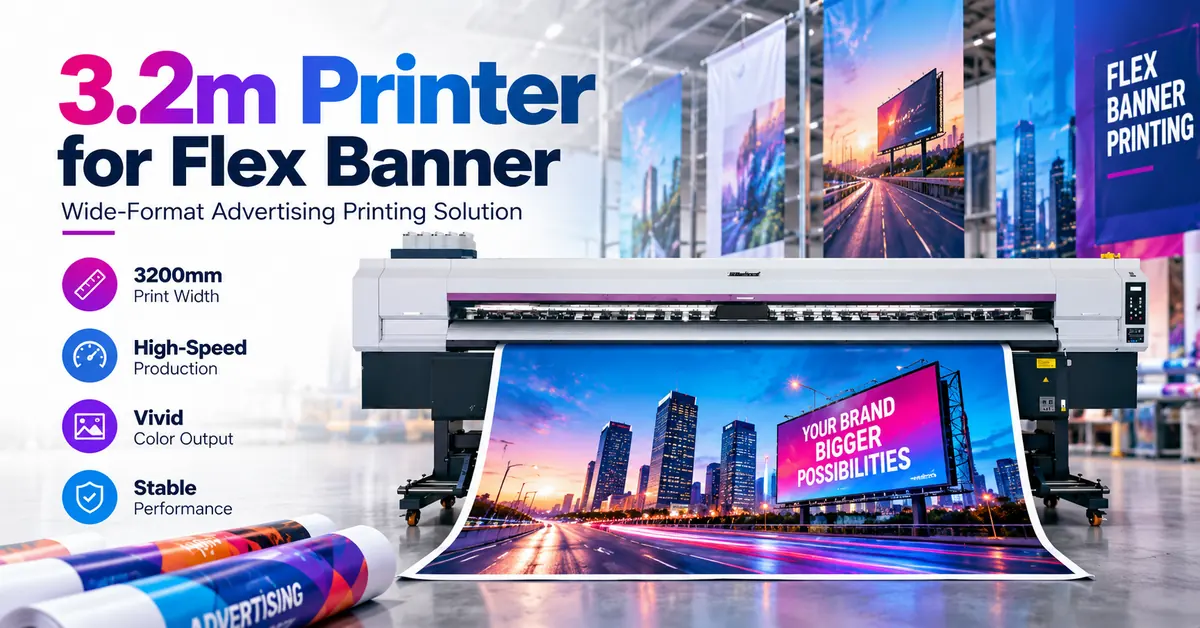
A 3.2m printer for flex banner production should be selected according to banner material, usable print width, roll weight, printing speed, media feeding stability, and finishing requirements. For commercial advertising factories, the right machine is not necessarily the one with the highest advertised speed. It is the one that consistently produces acceptable banners at a competitive cost per finished square meter.
A 3.2-meter wide-format printing system is particularly relevant to businesses producing outdoor advertising banners, promotional displays, construction-site graphics, exhibition backdrops, and large commercial signage. However, different printhead configurations, media-handling systems, and ink technologies can produce significantly different results.
For buyers comparing 3.2m banner printers, the most important checks are:
-
Can the machine handle the actual width, weight, and coating of your flex banner rolls?
-
Does it maintain acceptable image quality at your required production speed?
-
Can the feeding, heating, and take-up systems support continuous printing?
-
How much material is consumed after trimming, hemming, and finishing?
-
Does the manufacturer's quality testing match your production conditions?
This guide explains how to answer these questions, compare X-Roland's XL-3202Q, XL-3204Q, and XL-3202FA models, and prepare an informed equipment purchase.
1. What Is a 3.2m Flex Banner Printer?
A 3.2m flex banner printer is a large-format inkjet printing system designed to process wide rolls of compatible flexible advertising materials.
Flex banners commonly use PVC-coated or laminated polyester-reinforced substrates. These materials provide a printable surface and mechanical strength suitable for selected advertising and display applications.
Depending on the material and printing equipment, flex banner production may use solvent, eco-solvent, UV-curable, or latex printing technology.
A 3.2m printer for flex banner applications can help businesses produce wider graphics with fewer panel joins, provided the machine's usable print width accommodates the artwork and finishing allowances.
However, a machine advertised as 3200 mm wide does not necessarily provide a full 3200 mm of usable printed image width. Media margins, feed alignment, printer specifications, and production settings must be considered.
For businesses exploring compatible equipment, X-Roland offers a dedicated eco solvent printer product range covering different printing widths and production configurations.
2. Which Businesses Benefit Most From a 3.2m Printer?
A wide-format banner machine can serve several commercial printing sectors.
| Customer type | Common applications | Primary purchasing concern |
|---|---|---|
| Outdoor advertising manufacturers | Billboards, promotional banners, building-site graphics | Printing width and production capacity |
| Commercial print shops | Custom banners and retail promotions | Cost per finished banner |
| Signage production factories | Shopfront advertisements and directional graphics | Quality consistency and media versatility |
| Event graphics suppliers | Exhibition backdrops and event branding | Fast turnaround and finishing |
| Wholesale printing businesses | Bulk orders for advertising agencies | Repeatability and operating costs |
| Equipment distributors | Supplying commercial printing systems | Configuration, reliability and technical support |
Who Should Not Automatically Choose a 3.2m Printer?
A 3.2m machine may be excessive for a business handling mostly small stickers or narrow-format signage.
Similarly, businesses printing primarily on rigid boards, cotton garments, or untreated textile materials should evaluate the appropriate printing technology first.
A wider machine also demands sufficient installation space, media-handling equipment, ventilation, and finishing capacity.
The correct selection depends on how much profitable work genuinely requires wide-format production.
3. Which Flex Banner Materials Can Be Printed?
Material compatibility is one of the most important factors when selecting a commercial banner printer.
Frontlit PVC Flex Banner
Frontlit banners are intended primarily for graphics illuminated from the viewing side.
They are widely used for outdoor promotions, printed signs, advertising banners, and building displays.
Available constructions differ in surface finish, coating, fabric reinforcement, thickness, and weight.
Backlit Flex Banner
Backlit materials are designed for illuminated advertising applications.
Print density, light transmission, and surface uniformity are especially important when the finished graphic is viewed with lighting behind it.
Not every frontlit printing profile produces acceptable backlit results.
Mesh Banner
Mesh materials may be used for certain outdoor applications where reduced wind loading or partial airflow is desirable.
Mesh printing requires attention to ink penetration, the use of a suitable liner where necessary, media feeding, and the specific printer and ink system.
Blockout Banner
Blockout constructions are designed to limit light transmission and may be useful for certain hanging displays or double-sided graphics.
Double-sided printing and alignment capabilities must be evaluated separately rather than assumed.
| Flex banner material | Typical application | What to verify before production |
|---|---|---|
| Frontlit PVC | Outdoor signs and promotional banners | Ink adhesion, coating, drying and color |
| Backlit PVC | Illuminated advertising displays | Print density and transmitted-light appearance |
| Mesh banner | Selected outdoor building graphics | Feeding, liner, ink capture and finishing |
| Blockout banner | Hanging graphics and selected double-sided displays | Opacity, registration and compatible printing workflow |
| Heavy-duty reinforced PVC | Larger commercial installations | Roll weight, tensile properties and finishing strength |
Important: A material should be described as compatible only when the selected ink configuration and production process have been tested.
For additional advertising applications, explore X-Roland's printing application solutions.
4. Why Roll Weight Matters More Than Many Buyers Expect
One of the most overlooked purchasing considerations is the total weight of a full-width banner roll.
For example, a DERFLEX technical data sheet describes a 13 oz frontlit PVC banner material weighing approximately 440 grams per square meter. That figure is a material-specific reference, not a universal specification for all flex banners.
A simple roll-weight estimate is:
Roll material weight (kg) = Roll width (m) × Roll length (m) × Material weight (g/m²) ÷ 1000
Example: A 3.2m-Wide, 50m-Long Flex Banner Roll
| Variable | Example value |
|---|---|
| Roll width | 3.2 m |
| Roll length | 50 m |
| Material weight | 440 gsm |
| Total material area | 160 m² |
| Estimated material weight | 70.4 kg |
This calculation excludes the roll core and any additional packaging.
Why is this important?
The X-Roland XL-3202Q and XL-3204Q specifications each list an approximate 60 kg media-bearing capacity, while the XL-3202FA lists a maximum media load of 150 kg.
Therefore, the hypothetical 70.4 kg material roll would exceed the published approximate 60 kg capacity of the former configurations, even before accounting for the core.
This does not mean every 3.2m roll weighs 70 kg or that the XL-3202FA is automatically compatible with every heavy banner material. The buyer must also verify roll diameter, core size, loading method, media tension, and feeding performance.
For factories purchasing large rolls to reduce changeovers, these details can materially affect equipment selection.
5. X-Roland 3.2m Printer Models Compared
X-Roland, a brand associated with Guangzhou Jihui Electronic Equipment Co., Ltd., offers several wide-format configurations relevant to commercial advertising production.
The following comparison focuses on three available product pages rather than general industry estimates.
| Specification | XL-3202Q | XL-3204Q | XL-3202FA |
|---|---|---|---|
| Listed width | 3200 mm | 3200 mm | 3200 mm media |
| Printhead configuration | 2 × I3200 or F1080 | 4 × I3200 | 2 × I3200 |
| Published 4-pass speed | 30 m²/h with I3200 | 60 m²/h | 53 m²/h |
| Published 6-pass speed | Not listed for I3200 configuration | Not specified | 36 m²/h |
| Media-bearing capacity | Approx. 60 kg | Approx. 60 kg | Up to 150 kg |
| Ink supply | Continuous system | Continuous system | 1.5 L per color in listed setup |
| Production focus | Dual-head wide-format printing | Four-head wide-format printing | Higher-load media handling |
Figures are from the manufacturer's published product sheets. They are not measured side-by-side on the same banner material. Confirm the intended eco-solvent configuration and obtain a sample-based throughput test. The XL-3204Q figures apply to the 3204Q table, not automatically to the XL-3203Q.
XL-3202Q: Dual-Head 3.2m Printing
The X-Roland XL-3202Q offers a two-printhead platform with listed I3200 and F1080 options.
Its specifications include a bridge-frame structure, Hiwin linear guide rail, Leadshine servo motor, continuous ink supply, platform suction, carriage protection, and heating with air drying.
The published specification explicitly includes flex banners among the listed materials.
This model is worth evaluating when a print shop wants wide-format capability and its representative workload does not require the higher listed output of another configuration.
XL-3204Q: Four-Head Wide-Format Production
The X-Roland XL-3204Q uses four I3200 printheads in the published configuration.
The manufacturer lists 72 m²/h at 3 pass and 60 m²/h at 4 pass.
Its listed equipment features include a servo-driven carriage, continuous ink supply, partitioned suction, heating, and an automatic media-handling arrangement.
For factories handling higher volumes of advertising banners, this model may deserve consideration when production speed is a primary constraint.
However, a four-head configuration does not guarantee twice the accepted output of every dual-head system. Real performance depends on print mode, machine design, ink, media, and operator workflow.
XL-3202FA: Higher Media-Load Capability
The X-Roland XL-3202FA uses two I3200 printheads and lists 53 m²/h at 4 pass.
Its distinguishing published feature is a maximum media load of 150 kg, together with an integrated media-feeding system and heating arrangement.
This makes it an important comparison candidate for operations using heavier rolls.
However, its current product specifications list advertising canvas, lightbox fabric, film, and other media categories rather than explicitly confirming every PVC flex banner construction. Buyers should request a specific sample and feeding test before selecting it for heavy flex banner rolls.
The decision should follow your actual materials and workload—not the headline speed alone.
6. How Do Printheads Affect Banner Quality and Output?
Printhead selection influences production efficiency, image quality, ink compatibility, and service planning.
The Epson I3200 family includes different variants for different ink systems. Epson's technical information identifies the I3200-E1 variant for eco-solvent ink, while other variants are designed for aqueous or UV applications.
This distinction matters because printheads and inks are not freely interchangeable.
When comparing printer configurations, evaluate:
-
The exact printhead variant and compatible ink.
-
Nozzle-check results and repeatability during sustained runs.
-
Print modes required for large solid-color areas.
-
Banding, registration, and color consistency.
-
Printhead maintenance and replacement costs.
-
Availability of compatible ink, software, and spare parts.
Large banners often contain broad color backgrounds, gradients, logos, and photographic images. Banding or color variation that seems minor on a small test print can become highly visible across several meters.
Request full-size color samples and continuous printing demonstrations rather than relying only on a small showroom photograph.
7. Which Media-Handling Features Matter for Flex Banner Printing?
Banner material is wider, heavier, and sometimes more difficult to feed than lightweight adhesive film.
Three systems deserve particular attention.
Feeding and Take-Up Control
The unwinding and rewinding systems should maintain controlled media tension.
Incorrect tension can cause skew, wrinkles, unstable movement, or tracking errors.
Ask suppliers to test the printer with your actual roll length, weight, and winding direction.
Suction and Printhead Clearance
A suitable suction system helps keep media stable on the printing platform.
However, curled edges, raised seams, or warped banner material may increase the risk of head strikes.
Printhead clearance should be set according to manufacturer instructions and the actual substrate.
Heating and Drying
Heating and airflow must be balanced with the media coating and ink formulation.
Insufficient drying can cause blocking or handling problems, while excessive heating may distort certain flexible materials.
Ask for a demonstration that continues through take-up and finishing, not simply the moment the printed image leaves the print zone.
8. How Much Flex Banner Can a 3.2m Printer Produce Per Day?
A 3.2m printer for flex banner production should be evaluated using accepted output rather than maximum advertised printing speed.
Consider a hypothetical XL-3202Q production plan using the listed I3200 four-pass reference speed of 30 m²/h.
Assume:
-
An eight-hour scheduled shift.
-
Six hours of actual productive printing time.
-
A 90% accepted-output rate.
-
A representative banner material and print mode.
Estimated accepted output:
30 m²/h × 6 hours × 90% = 162 m²/day
This is only a planning example. Actual performance may differ substantially, and the advertised printing speed must first be verified on the required material.
Finishing, cutting, roll changes, and packing may require additional time or become separate production bottlenecks.
A buyer should obtain a test report showing the actual printing time, measured printed area, accepted print area, material usage, and any rejected output.
9. How Do Banner Finishing Requirements Affect Material Waste?
A commercial banner is not necessarily complete when it leaves the printer.
Depending on the installation, it may need trimming, hemming, heat welding, sewing, grommets, reinforced edges, or joining multiple panels.
These processes influence how much material must be purchased.
Example: A Finished Banner Measuring 3m × 5m
Assume the job requires 75mm of additional material on each side and 100mm at both ends for an agreed finishing process.
| Measurement | Example |
|---|---|
| Finished banner area | 15 m² |
| Required material width | 3.15 m |
| Required material length | 5.20 m |
| Material area before finishing | 16.38 m² |
| Extra material compared with finished area | 9.2% |
These allowances are illustrative. Actual hem dimensions and finishing details depend on the installation design.
This example shows why buyers should not calculate banner material costs using only the final visible dimensions.
The factory must also verify that its printable width and media-handling system can accommodate the layout and required finishing zones.
Where banners are exposed to wind, mechanical loading, or prolonged outdoor conditions, appropriate material strength, reinforcement, anchoring, and installation design are essential.
10. How to Calculate the Real Cost of Flex Banner Printing
The cost of a 3.2m printer for flex banner operation is best evaluated per accepted and finished banner.
Key cost components include:
-
Flex banner media.
-
Ink and cleaning consumables.
-
Electricity and operating labor.
-
Printer maintenance and equipment allocation.
-
Trimming, hemming, welding, and grommets.
-
Reprints and damaged material.
-
Packing and delivery.
A practical calculation is:
Cost per finished banner = Total attributable production and finishing costs ÷ Number of accepted finished banners
For example, if a production batch incurs $400 in total attributable costs and yields 20 accepted banners, the calculated cost is $20 per accepted banner.
This is a hypothetical calculation—not a current X-Roland equipment or printing price.
Compare this cost with your customer selling price, required margin, monthly order volume, and current outsourcing expenses.
Also consider downtime. A seemingly inexpensive printer can become costly if a failed component causes repeated missed delivery deadlines.
11. What Quality-Control Tests Should Buyers Request?
Before investing in wide-format equipment, request a factory demonstration using representative flex banner materials.
A practical acceptance process should include five stages.
1. Material Verification
Confirm media width, thickness, weight, coating, and compatibility with the quoted ink configuration.
2. Print Quality Inspection
Examine solid colors, fine text, gradients, banding, image registration, and printing consistency.
3. Continuous Feeding Test
Print a representative long job to evaluate media tracking, suction, heating, and take-up performance.
4. Finishing Test
Check the printed material after the agreed drying interval and planned trimming, welding, or hemming operations.
5. Repeatability and Documentation
Record print mode, RIP settings, ink configuration, media specification, accepted output, and inspection results.
Guangzhou Jihui Electronic Equipment Co., Ltd. describes factory quality-control activities covering incoming material inspection, platform adjustment, equipment assembly, functional testing, and shipment inspection.
Buyers can review the X-Roland manufacturing and quality-control approach and request machine-specific factory testing documentation.
For specialty banner applications, compliance or performance claims should be supported by relevant material tests and documents. Do not assume that a machine certificate establishes the flame performance, wind resistance, or outdoor lifespan of a finished banner.
12. What Should International Buyers Confirm Before Ordering?
An overseas advertising equipment buyer should review the complete production and purchasing arrangement.
Important details include the selected ink system, machine dimensions, loading capacity, voltage, printhead configuration, software, installation requirements, consumables, spare parts, shipping terms, and warranty conditions.
The manufacturer should also clarify the scope of available training, troubleshooting, and technical support.
X-Roland's published equipment services describe a workflow that begins with customer materials, artwork, production volume, and desired results, followed by equipment recommendations, sample review, and rollout support.
For distributors or customers requesting OEM/ODM options, equipment branding, specific configurations, documentation, quantities, and lead times should be confirmed in a formal quotation.
What Should You Include in a Flex Banner Printer RFQ?
To receive a relevant recommendation, provide:
-
Your main flex banner materials, including weight and roll dimensions.
-
Typical finished banner sizes and finishing methods.
-
Required accepted output per day or month.
-
Target printing quality and representative artwork.
-
Preferred ink technology and operating environment.
-
Installation country, electrical requirements, and shipping destination.
Need a model recommendation? Contact X-Roland to discuss XL-3202Q, XL-3204Q, and XL-3202FA configurations against your banner samples and production requirements.
Frequently Asked Questions
1. Is a 3.2m printer suitable for outdoor flex banner production?
Yes, a properly configured 3.2m wide-format printer can be suitable for compatible outdoor advertising banner materials. Buyers should verify ink adhesion, usable width, roll capacity, drying, and finishing performance. Outdoor durability depends on the complete ink-media combination and exposure conditions.
2. What is the difference between a 3.2m and a 1.8m flex banner printer?
The main difference is available printing width. A 3.2m system can accommodate wider graphics and may reduce the need for joining multiple panels. However, it generally requires more working space and suitable media-handling equipment.
3. Which is better for flex banner printing: two printheads or four printheads?
Neither configuration is universally better. Four printheads may provide higher potential throughput, while dual-head configurations can suit different production budgets and workloads. Buyers should compare accepted output on the same flex banner material and print mode.
4. Can an eco solvent printer print PVC flex banners?
Yes, many appropriately coated PVC flex banners are designed for compatible eco-solvent inkjet systems. Always confirm the material supplier's printability specifications and test the actual ink, coating, and printer configuration before production.
5. What is the maximum roll weight a 3.2m printer can handle?
Capacity varies by model. X-Roland lists approximately 60 kg media-bearing capacity for the XL-3202Q and XL-3204Q, and up to 150 kg for the XL-3202FA. Buyers must also verify roll diameter, core dimensions, feeding stability, and safety instructions.
6. How fast can a 3.2m banner printer print?
Published reference speeds vary with printhead configuration and print mode. For example, X-Roland lists 30 m²/h for XL-3202Q, 60 m²/h for XL-3204Q, and 53 m²/h for XL-3202FA at specified four-pass settings. Actual accepted output must be verified in a representative production test.
7. Does a 3.2m printer always provide 3200mm of printable width?
No. Advertised media width and usable printing width may differ. Allow for machine margins, alignment requirements, and finishing dimensions. Confirm the selected machine's usable print area before designing near-full-width graphics.
8. What causes wrinkles or feeding problems during flex banner printing?
Possible causes include incorrect tension, uneven winding, incompatible roll dimensions, material curl, heating conditions, or poor alignment. The feeding and take-up systems should be tested with the actual material before full-scale production.
9. How can a printing factory reduce flex banner production costs?
Start by measuring material utilization, rejected output, ink use, feeding stability, finishing losses, and labor time. Compare costs per accepted finished banner rather than advertised machine speed alone. Optimize nesting and process settings without compromising agreed print quality.
10. How can I choose a reliable 3.2m banner printer manufacturer in China?
Verify the company's identity, manufacturing capabilities, published specifications, application samples, quality-control procedures, parts availability, and after-sales commitments. Request a production demonstration using your actual banner material and obtain a written quotation covering the complete equipment configuration.
Conclusion
Choosing a 3.2m printer for flex banner production involves more than comparing printing width and advertised speed. The correct machine must handle your banner materials, support stable roll feeding, meet quality requirements, and produce finished graphics at a sustainable commercial cost.
The X-Roland XL-3202Q, XL-3204Q, and XL-3202FA provide different configuration choices for wide-format printing operations. The XL-3202Q offers a dual-head platform, the XL-3204Q provides a four-head configuration with higher listed throughput, and the XL-3202FA offers a higher published media-load capacity. Each should be evaluated against the buyer's actual ink system, roll specification, printing requirements, and finishing workflow.
For advertising manufacturers, sign-making factories, commercial printing businesses, and overseas equipment distributors, the most dependable purchasing approach is to test representative materials, calculate accepted production output, and confirm technical support before ordering.
Looking for a 3.2m flex banner printing solution? Contact X-Roland for a technical recommendation and quotation. Share your flex banner specifications, roll dimensions, artwork, and production targets so the team can help you evaluate a suitable wide-format printing configuration.